Home

News Galore: Upcoming Breeding, AWPGA National Specialty and Pupdates

1 Comment

Upcoming Breeding

Sue is coming into the very first stages of heat.  I’m going to take photos and document the whole process for a future article, which I don’t think will be of much interest and will probably kinda gross out some of my readers, but when I was getting my internet education and book learning on the physiology of a female’s heat cycle, the only photographs I could find were from toy dogs and it helped me out some, but I would like to get it down for the future of the Wirehaired Pointing Griffon breed.

But back to Sue, she is probably 2-4 weeks away from breeding, so that puts whelping in February-March and puppy homegoing in April-May.  I currently have six reservations with deposit, therefore the entire breeding may already be sold, but there is a possibility for additional puppies from this litter.  We will also have a litter from Sam and Mae this spring.  For information about our current breeding dogs, please click on the “About Our Dogs” button up at the top of the page.  This will be Sue’s fourth and last litter.

Hunting Season Progress

Charles, Sam and BB had a great trip to North Dakota at the end of October, make sure to check it out on the Hunting Blog (versatilehunter.com or just click the button at the top of the page).  We’ve all taken a mid-season break, Charles has been spending time in the deer woods (even though our freezer is full of birds and I keep begging him not to go since we don’t have room for one) and I’ve had a spell of illness.  I know that Charles and his friend Matt have a trip to Kansas planned for next weekend, but I probably won’t get out in the field until Christmas, as I had surgery on my upper jaw a couple of weeks ago and I want that to fully heal before putting a shotgun up to my face.  So my dog time has mainly been spent in just daily exercise and socialization.

Caleb and Sam enjoying some play time
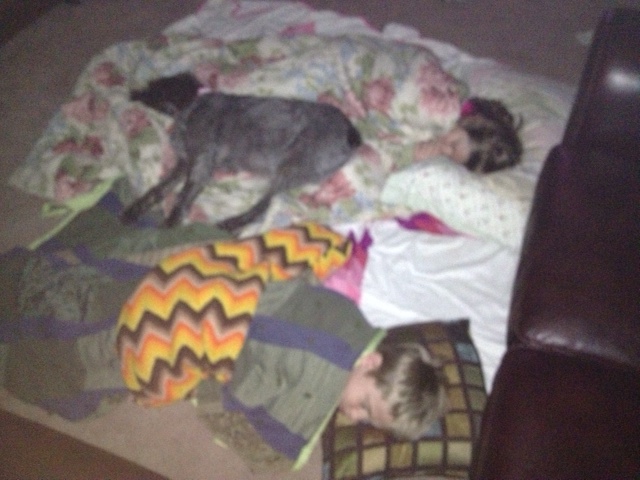
Cordelia and Conrad having a slumber party with BB

A Brief History of the AWPGA

I recently had an e-mail question from a puppy buyer about the AWPGA vs. the WPGCA.  I might as well take the time to explain it here for everyone’s benefit.  Back in the 1980’s there occurred what I call “The Great Schism”.  Similar to the medieval division of the Christian church, Griffondom came to a loggerhead and there were two groups who could no longer co-exist.  The WPGCA was the original breed club in the United States, but many of the controlling individuals were concerned that the hunting ability of the purebred genepool at that time was compromised and that there was an irreparable genetic depression that required an infusion from another breed to avoid total collapse in not only the health of the breed, but in their abilities as Korthals intended.  Therefore this group decided to crossbreed with the Cesky Fousek, a similar breed from then Czechoslovakia.  A detailed history of the breed and the club can be read in Joan Bailey’s book Griffon: Gun Dog Supreme.  Mrs. Bailey was part of the crossbreeder element and stayed with the WPGCA, so the breakup is not mentioned in her book.

In crossbreeding, the WPGCA created dogs not recognized by the American Kennel Club or the North American Versatile Hunting Dog Association.  They intentionally created a designer hunting mutt.

A brave group of individuals decided to leave the WPGCA and form the AWPGA to preserve the purity of the breed and retain purebred status with the AKC and NAVHDA.  Through concerted private effort across North America, AKC/NAVHDA breeders took steps to ensure that the genetics and hunting ability were bolstered.  Importations of purebred griffons occurred at that time and continue to this day from the Netherlands, Germany and France.  Hunt testing through NAVHDA and the AKC has been emphasized.  Participation in AKC conformation dog shows is yet another important element to make sure that our breeding stock is fitting the original mold intended.

The effort has been an astounding success.  The breed had its first sporting group placement at the Westminster Kennel Club dog show in 2011 by GCH Fireside’s Spontaneous Combustion.  Griffons were the second largest group of Utility Prize I dogs tested for their Versatile Champion title at the NAVHDA Invitational this year.

We continue to promote genetic diversity through a team approach, making sure that our bloodlines do not become too tightly inbred by buying breeding stock from one another or utilizing outside studs.  With 30 years of hard work behind them, the veterans of the AWPGA can declare a victory in this battle and us youngsters can appreciate their efforts and continue the work that lies ahead.

AWPGA National Specialty

Every year in October the AWPGA has their National Specialty dog show and convention in a different region of the United States.  This year was the midwest region’s turn and it was being held right up the road in Sioux Falls, South Dakota.  Plus it was being chaired by my friend Kay Farris, who is just an amazing lady.  She has handled her own dogs to conformation championships and is organizer extraordinaire for the Midwest Tri-State NAVHDA Chapter, which also moonlights as an AKC club called the South Dakota Pointing Dog Club.  Kay and I have gotten to know each other through showing our dogs this summer up in Minnesota, plus she has been test secretary at all of the testing we’ve done or have considered doing in Sioux Falls.

I almost cancelled my reservation to nationals at the last minute.  It was my first time going and breeders have a bad habit of thinking that we have seances with Korthals himself, know exactly his intentions for what the breed should be and everyone else just doesn’t quite have it exactly right.  I thought for sure that I would be picked on and snubbed as a newcomer.  But I was excited to meet the people that I had been talking to online and at a minimum I knew Larry and Paula Woodward are nice, as we’ve tested with them around here before.  So we went.  Charles, BB and Sam met Mae and I on the night of Wednesday, October 24th on their way home from North Dakota at the host hotel, the Best Western Ramkota Inn in Sioux Falls.

We had decided to attend Thursday’s NAVHDA Natural Ability test handler’s clinic for a couple of reasons.  The first being that even though Charles handled BB to a Prize I with a maximum score of 112 at the Heartland Chapter’s Spring NAVHDA Natural Ability test, we were winging it to an extent.  We knew the elements that were to be tested, just assuming that our normal training and exposure for hunting would suffice and it did.  Yet we wanted to learn the specifics of the judging of the elements being tested.  Secondly, I’d been dying to meet one of the presenters, Bill Jensen.  Bill has owned and bred Wirehaired Pointing Griffons as Alder’s Edge Kennel of Minnesota for decades and has also served as a longtime NAVHDA judge.  Joan Bailey’s book Griffon: Gun Dog Supreme gives credit to Bill and his late wife Barb as being instrumental in establishment of the breed in North America. (You can click on any of the photos to enlarge them)
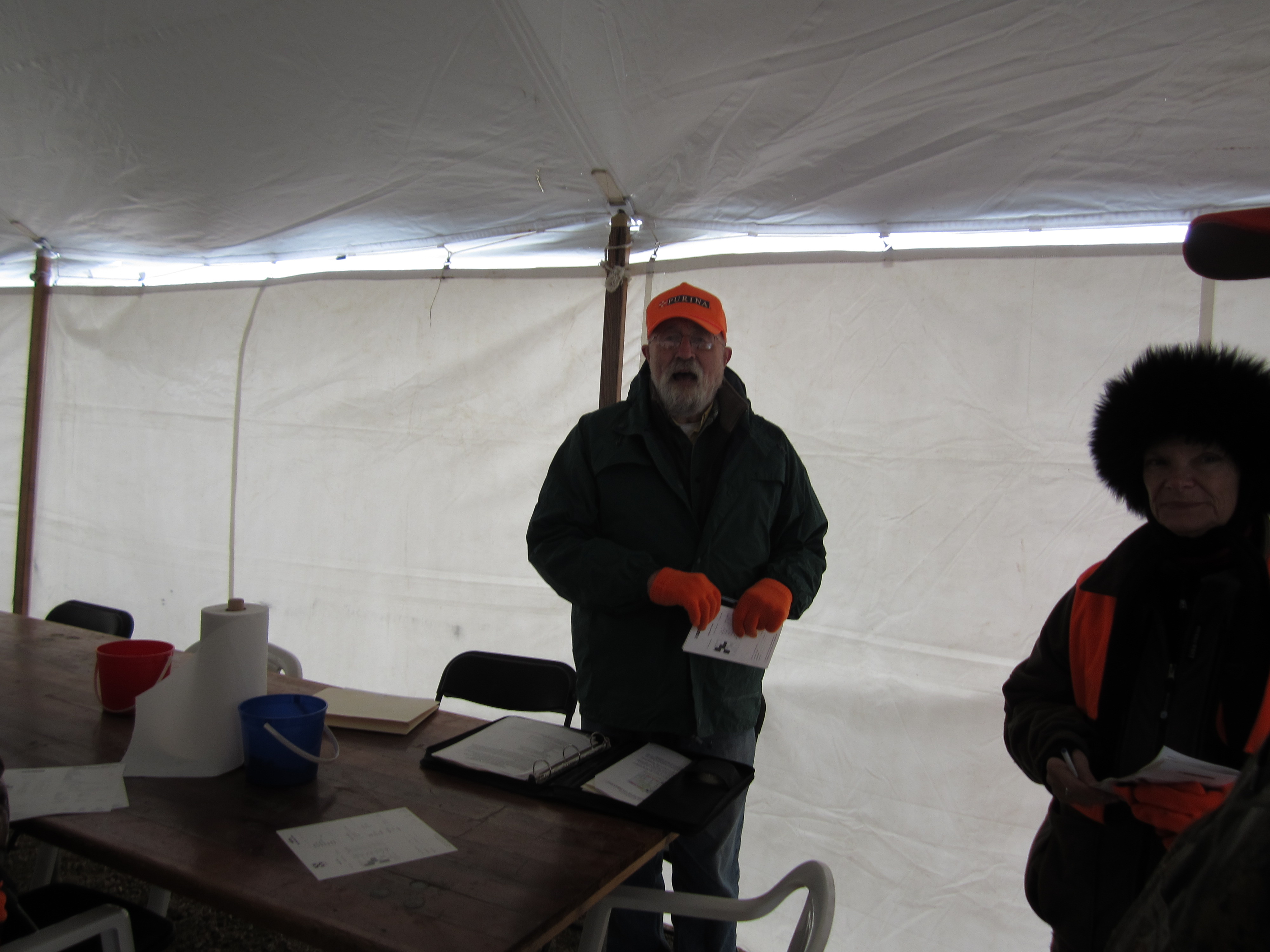
Bill Jensen gives instructions for the field portion of the handler’s clinic

Early morning lots of big, fat, wet snowflakes fell upon the dog walkers.  We were all walking griffons, so we greeted one another with a nod or a grunt, but it was too cold and dark for proper introductions just yet.  Luckily, Kay had accounted for the morning weather for our NAVHDA Natural Ability test handler’s clinic that day and we were first meeting for explanations from and discussions with our presenters at the hotel up until lunch time.  In addition to Bill, we had two other experts present: Larry Woodward of Aux Lake Kennel in Kansas who has successfully handled in countless NAVHDA and AKC tests, including NAVHDA Invitational and AKC Master Hunter.

Larry Woodward (left) giving additional instruction for the field portion of the handler’s clinic

Our third expert was NAVHDA judge and new griffon breeder from Connecticut, Mike O’Donnell.

Mike O’ Donnell prepares to throw a chukar into the water for a dog who was struggling to retrieve the bumper

There were close to the maximum of 25 attendees at the session, with most of us being relatively new to the breed (we’ve had griffons for 8 years, compared to some who have 30-40 years) and spent a good three and a half hours at the hotel talking to the experts about training and testing.  We then went out west of town to the field grounds and had a delicious lunch of chili, BBQ sandwiches and fixings graciously prepared by Cliff Koele (also an expert handler for NAVHDA Invitational and breeder through Coppershot Griffons of Iowa), Rick Farris (Kay’s husband, UT I handler and Dakotah Griffons breeder) and the other members of the Midwest Tri-State NAVHDA chapter.
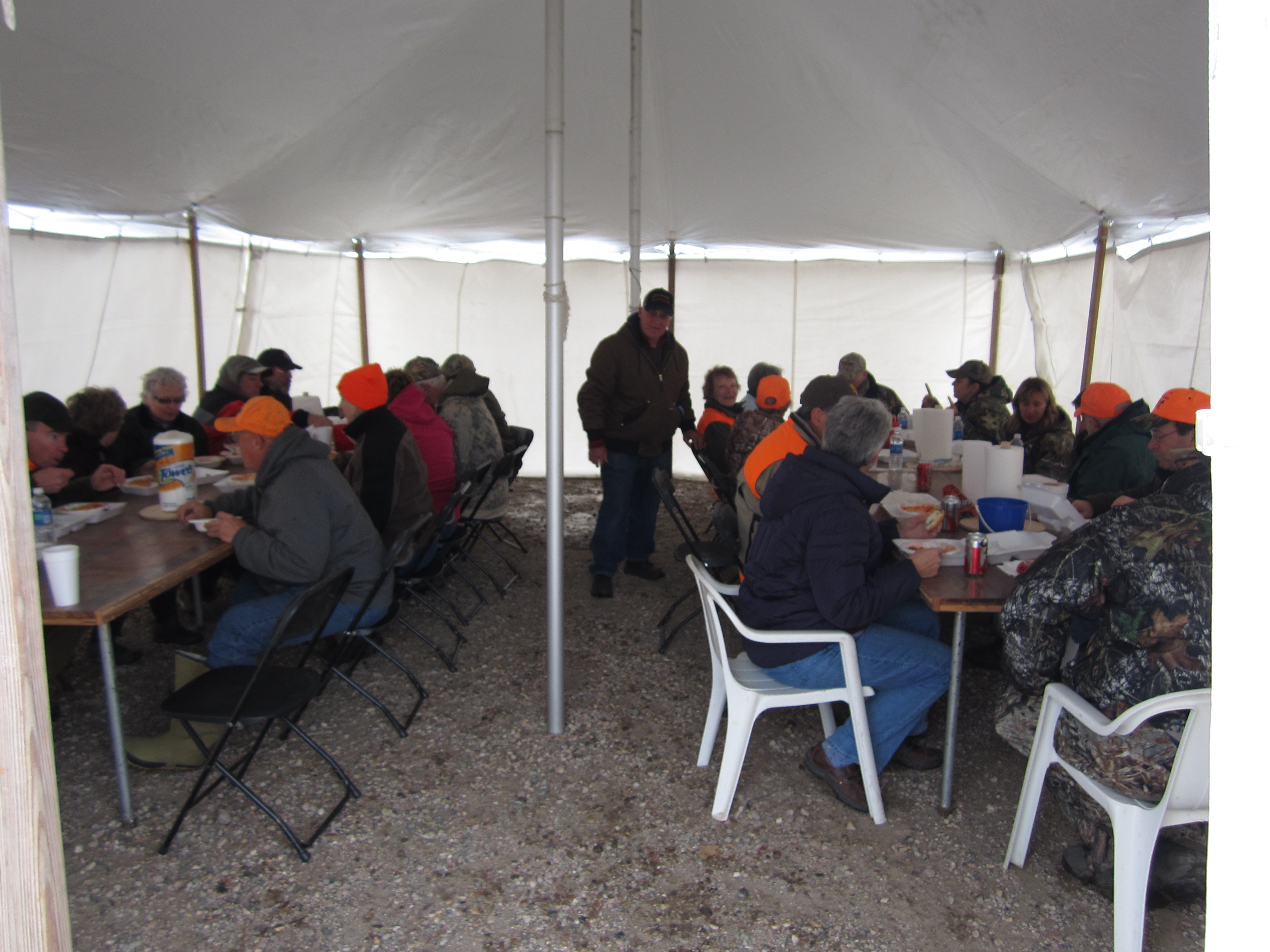
Field lunch on Thursday, Cliff Koele standing in the middle

After lunch we hit a very cold, wet and windy field to practice judging two different pups in a mock NAVHDA Natural Ability test.  The first had never been tested and had little field training, whereas the second had a Prize I with a 112 score on the test.  It was very interesting to judge each of the elements and talk to one another and the judges about we agreed or disagreed on the scoring.  By the time we wrapped everything up around 4 PM, we were down to less than half of the number of people we started with due to the cold and wet.  Even though Charles and I were very underdressed (we thought we were tired of wearing our hunting gear and foolishly wore street clothes), we shivered our way through the end, but there were many from the southern climes that just weren’t used to it.  We really enjoyed the clinic and it was a great way to get to know our fellow attendees before the whole social scene hit.

There was just enough time to head back to the hotel and thaw out before the welcome reception Thursday evening.  There were lots of yummy hors d’oeuvres (you know, snacks) and as one of my friends said, it was “Facebook comes alive!”  It was fun to finally talk face to face to some of the people I had been chatting with on the internet for some time and have a few drinks with them, but the festivities didn’t last too long because Friday was an early morning at the dog show.

Chatting around the hors d’oeurves table, the folks I recognize (from L to R): Pat McKinley, Vicky Foster, Amy Caswell-O’Clair, Bill Jensen, not sure of the lady getting food, Charles Upchurch (at the back of the room), Meghan Sweeney-Vos, Anne Summerfelt (I think, back of her head) is facing Dawn Connor-Wood, with Kristi Rogney on the far right.

The dog show folks started rumbling around the hotel at about 5 AM, getting the dogs walked and gear loaded up to move over to the fairgrounds, we were setting up grooming tables between 6-7 AM, with the first of the griffs in the ring at 8 AM.

Reserved grooming area for Wirehaired Pointing Griffons. Jody Kirtley grooming, Willie Garrou grooming, Brooke Garrou walking dog.
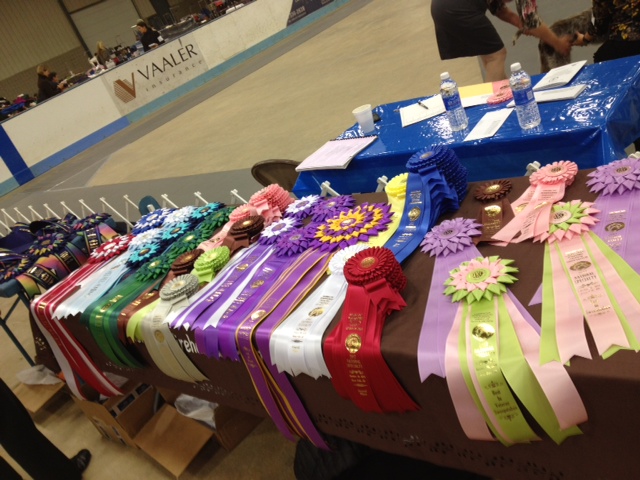
2012 National Specialty bling, organized by Tajia Retzlaff and Meghan Sweeney-Vos

Mae and I had spent months practicing conformation handling at the local dog club, but you never know how a dog is going to perform from one day to the next.  I am an inexperienced handler and Mae was really a stubborn pain, so this was her first and last time in the ring.  I was very shocked that we actually took home a ribbon, I call it my pity prize.  We took 2nd in Hunting Bitch class and I’m so tickled over it that this is still my profile picture on Facebook:

Charity and “Mae” AKC/NAVHDA Little Lady Aspen NA II take 2nd place in the Hunting Bitch Class at the 2012 American Wirehaired Pointing Griffon Association National Specialty

Close-up of my ribbon

The whole day was very emotional and intense, especially seeing between 25-30 griffs in the ring for the Best of Breed competition.  I have no idea how long it took the judge to evaluate all of the dogs, but it felt like time was standing still and that nobody was breathing.
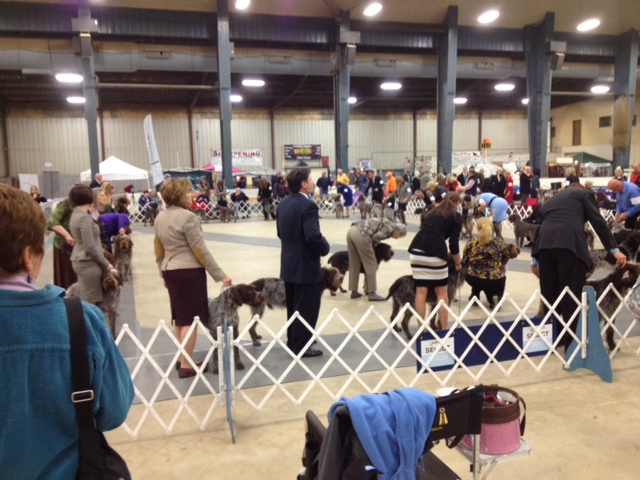
Everyone in the ring for best of breed. This one is tough to label, I see Lisa Durand’s pro handler on the far left, I see Lorraine Rothrock with her back to us with the blonde ponytail kneeling down and Larry Woodward is on the very far right with the blue shirt.

Dawn Connor-Wood’s female “Wilo” won best of breed, which was met by many tears from the owner and much excitement from the crowd.  The full results from the National Specialty dog show are available at http://www.onofrio.com/execpgm/wbsrbred?wtsrk1=EMPI1619041WPG

Wilo’s handler, Dawn Connor-Wood and Wilo, 2012 Best of Breed.

We were supposed to go into the annual meeting one-half hour following the dog show, but everyone was so emotionally drained from the intensity of the morning that it was delayed until our pizza supper in the evening.  Many of us spent the afternoon touring and shopping in Sioux Falls.
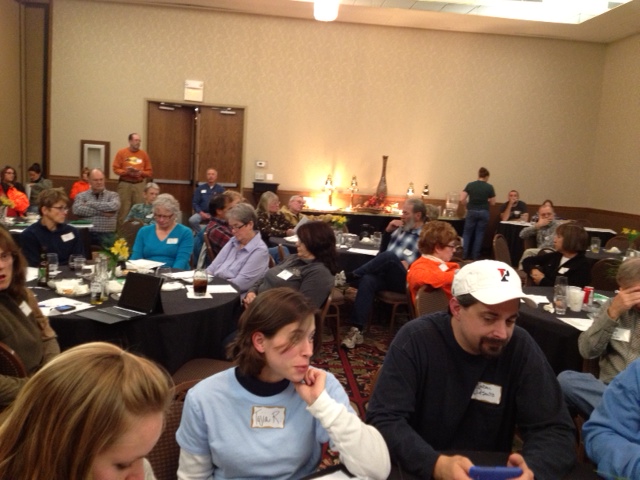
Pizza dinner and annual meeting. Front table (L to R) Meghan Sweeney-Vos, Tajia Retzlaff and Kendall Santos.

The annual meeting lasted around four hours, from 6 PM until 10 PM, but it still felt like we had only scratched the surface of what we all wanted to talk about.  I’m sure that if we had started the meeting at 1:30 PM as was planned, we would have been there all day AND all evening.  It was all very civil discourse and debate.

Many of us did the dog show on Saturday, others ran in the Korthals Cup competition, which I never made it out to, but I assume was very similar to the NAVHDA or AKC Hunt Test formats.  But my highlight of the day was the Saturday night banquet and auction.  Not only was the food delicious (prime rib and all the trimmings), but we all just really had a good time after getting to know each other over the weekend: having drinks, sharing more stories, cheering for the award winners and bidding up auction items to fund the club.  There were a lot of laughs shared that night, it was awesome.

Kay Farris addresses the crowd at the banquet

There were folks still going Sunday morning, some headed back to the dog show, others back to the Korthals Cup with the final event of the wild game lunch at the field, but Charles and I needed to go home. The kids were crying that they hadn’t seen their dad in two weeks and mom had been gone too long.  I wish we’d had more time to chat with everyone in Sioux Falls, it just felt so crazy and intense the whole time.

There are so many people I’ve neglected to mention and shout out to, I’m just going to run down a list.  Thank you, Dick Byrne (Flatbrook’s Sporting Dogs, California), veteran member, for making us feel welcome.  Thank you, Kristi Rogney (Whiskeytown Sporting Dogs, California), then acting president, for tactful management of the annual meeting and of course, your friendship.  Thank you, Dawn Connor-Wood, for an amazingly professional treasury report.  Thank you, Willie and Brooke Garrou, for hanging out with us at the specialty dog show.  Thank you, George Kline, for being a humorous emcee of the banquet and just an all-around funny guy to hang around (oh, and I got the car magnet that you sent us, thank you again!!!).  Thank you, Patty Geist of Kearney for showing up so that we weren’t the only Nebraskans!  Thank you, Vicky Foster for helping me in the show ring, you are my new hero for expertly handling your own dog in both the show ring and field tests.  Thank you to Glenn Kroese for showing me how to put my show lead on the dog correctly after the judge got after me about it.  Thank you, Elaine Hunsicker (Fireside Sporting Dogs, Maryland) for chatting with me about “The Great Schism” at the dog show, it was cool to finally meet someone in person who was there when it happened and willing to talk about it.  Thank you to Julie Carlstrom (de Jac Pine Kennels, Wisconsin), judge at the Korthals Cup, for chatting with us about our recently acquired co-owned female, NAVHDA de Jac Pine’s Zip-A-Dee-Doo-Dah. I know that Charles would like to thank Mike O’Donnell for lots of good conversation.

Thank you to all of our other many new friends that we’re so excited to hang out with again next year in Colorado.  If you are a Wirehaired Pointing Griffon enthusiast, are reading this and are not a member of the AWPGA, please consider joining by going to awpga.com, click on “The Club” at the top, read the By-Laws and the Code of Ethics in the dropdown menu, then go all the way to the bottom of the dropdown menu and fill out an application form. Then plan on joining us in October of next year in Denver, Colorado for the 2013 shindig!!

Pupdates

Seven month old TracHer, from our Sam/Mae C Litter  is out chasing lots of pheasants in North Dakota!
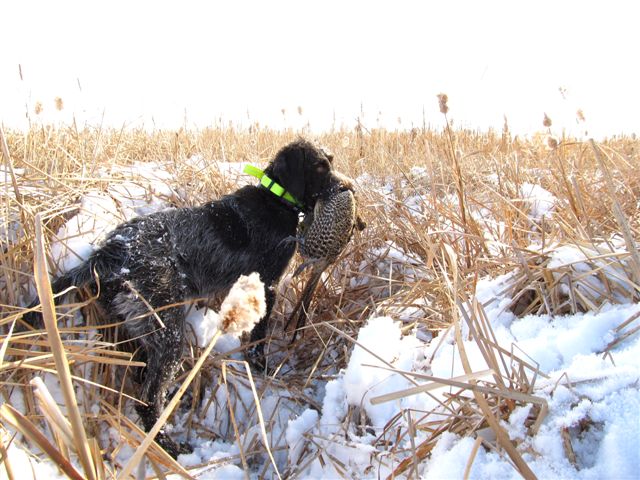
Seven month old TracHer, female Wirehaired Pointing Griffon, practicing her retrieve on a pheasant in the snows of North Dakota.

TracHer’s C Litter sister Frankie, who lives in Colorado, took a trip to Kansas where she worked hard searching the fields, having some stylish and staunch points.

Frankie, 7 month old female Wirehaired Pointing Griffon, searching the fields of Kansas for some roosters.

Five month old Gomer, from our Sue/Sam D litter is learning how to retrieve antlers out in Illinois.

Gomer, five month old male Wirehaired Pointing Griffon, looking handsome in the yard.

Gomer’s D Litter sister Dottie followed along with some other dogs on opening weekend in Nebraska.  She’s just learning the ropes with pointing and retrieving, but loved to pose for this photo.

Dottie, female Wirehaired Pointing Griffon, 5 months, with some Southeastern Nebraska roosters

Thanksgiving!

Wishing you all a very blessed Thanksgiving.  I am very thankful for my readers, who seem to enjoy partaking of this silliness.  I am also thankful to be healthy enough to finally write a post, as obviously I’ve been holding it all in and had to spend most of today writing!

Nebraska and North Dakota Pheasants

1 Comment

One doesn’t hunt in order to kill, on the contrary, one kills to have hunted.

-Jose Ortega y Gasset

There is a nauseating thread in upland bird hunting writing these days that the hunt really isn’t about the size of the game bag at the end of the day, but is really some sort of quasi-religious experience where we are communing with nature and bonding with our fellow hunters and our dogs, waiting for some sort of epiphany to occur out in the field.  I first saw it start to crop up in the blogosphere, but it has since bled over into magazine and newspaper articles.

It sounds to me like an excuse used by people who aren’t hunting smart and hard or by state game officials when they aren’t properly managing habitat.  The drought this year has led to almost all of the CRP land in southeastern Nebraska to be hayed or grazed, leaving hunters with very few options to chase roosters nearby.  The general agricultural climate of eastern Nebraska as a whole, with grain prices as high as they are, has become an annual limiting factor regardless of the weather conditions for the year.  We can’t ask farmers not to farm, that’s their job, but the Nebraska Game and Parks needs to consider expanding their current pheasant stocking program to all wildlife management areas in the Lincoln-Omaha area.

You didn’t know that NGPC was stocking pheasants?  They claim it is for the youth hunting weekend, but we suspect that it is a pilot stocking program looking to salvage what is left of upland bird hunting culture in the urban part of our state.  I’ve said it before and I’ll say it again: NGPC has no problem managing several fish hatcheries and openly stocking fish.  Heck, I get updates on Facebook when they stock trout and exactly where they do it.  Stock more pheasants in southeastern Nebraska.  How did they get here in the first place, did they fly from China?!? (That’s a rhetorical question of course.  The current rooster-bearing states were stocked many times in order to establish a sustainable population.)

Here’s a shot of a rooster that we planted in April on a friend’s land along the Platte River in Cass County, where we have never seen pheasants at all before, Charles and Sam harvested him last weekend.

Wirehaired Pointing Griffon, Sam, and the first Nebraska rooster from Saturday

I know that NGPC and Pheasants Forever think that the sole focus needs to be on habitat, but if there aren’t any birds to manage habitat for, then what is the point?!?  We were so excited for our friend, Matt, who took our oldest female griffon Sue out last Friday to some of the WMA’s that had been stocked.  He got his first limit of roosters ever and was completely ecstatic.  Tell him that the size of the game bag doesn’t matter.

Which is why Charles, like many other “dog men”, take the dogs north for wild bird training for a week each year.  All of the kumbayaing over hunting spirituality in the world doesn’t replace sheer grit and determination to give your dogs the most wild bird contact possible each year.  Charles has chosen North Dakota as his annual destination.  One of my fellow griffoniers brought his two dogs out to Montana from the east coast and didn’t realize the huge learning curve that it takes to get a dog educated to the behavior of particular upland game birds, the wily rooster pheasant especially.  They took one rooster over a few days, then he boxed his dogs and brought out the guide’s dogs.  Over the guides dogs they took several roosters and some Hungarian partridge too.  Appreciation of the dew on the grass and the wind on your face doesn’t give the dogs that education.  Getting up before the sun comes up on day 4 of a pheasant hunt, stinking because you haven’t taken a shower the whole time, stiff and sore from the physical exertion and because you’ve been sleeping in the back of your SUV is not fun or religious.  But it is necessary.  Just like killing.

Sam and BB with the birds hanging at the end of day 2 in North Dakota.

I’ve been known to cry over getting skunked on a day.  I’ve felt guilty as hell when my dogs have worked their asses off tracking a rooster, then pin it down with perfect double points, only to have me wreck it on the shot.  The dogs hate it too, you can tell they get upset with me.

 Although ancient hunters recognized the religious and spiritual nature of the hunt, they did so in order to increase the size of their harvest.  In the fall and winter, we all still look up at the constellation Orion at night and hope he blesses our efforts.  But to succeed is to kill.  There is no way around that with hunting.

Charles and the dogs’ bird total from 3 days in North Dakota: 2 ducks, 3 sharptail grouse and 8 roosters. They took a few more before they packed up and left the following day.

A big mixed bag: October in the Sandhills

Leave a comment

A cold north wind welcomed us to hunting sharptail grouse on the Thursday before duck opener, easily blowing 30, if not 40 mph and the air temperature never peaked the 40 degree mark on the day.  It was a pretty brutal start considering that when we left Eastern Nebraska the evening before, it was 70 degrees.  I hadn’t even packed my kids jackets, let alone my winter upland gear, so I had to tough it out in my hunting shirt/t-shirt combo.  Luckily a person warms up quickly stomping around the dunes and running after birds.

I’ll admit that I was whining and not wanting to get out of the truck at first.  I whined my way out of the usual first spot and asked if we could scout for ducks instead.  As we were creeping around a pond looking to see if any ducks had arrived, we noticed some sharptails running down the road.  We thought we had ourselves an easy pick, so we backed up around a dune and unloaded our gear.  Of course we wouldn’t need the dogs, the birds were just 15 feet away, right?

I think we chased them for a good 30 minutes and got up 3 or 4 times before they were flushing close enough to get a shot, even though they were flying into the monstrous wind.  Ryan and I got off a few Hail Mary cracks on the edge of range before Charles put the first one in the bag.  I captured his retrieve in the first half of this video (the second half is from me on Saturday, but we’ll get to that part later).  http://www.youtube.com/watch?v=T4XgYQOzM8c

As we had been walking for a good hour and had left everything unlocked, I made a bee-line back to the truck while the guys chased the rest of that group, with Charles taking one more.  Once we got back, secured our things and brought out some dogs, we took a brief hike into some nearby dunes with Charles taking his third bird in no time.  Ryan and I had no hard feelings that we didn’t take any on the day and were ready to head back to town to get out of the wind and cold.

Sue, Mae and BB are excited that dad shot some grouse.

Friday’s weather was less windy and warmer, we decided that we wanted to split up, so we headed to a spot that I had navigated on my own before and it had cell phone coverage so that I could communicate with the guys.  We set out to make it a “short grouse hunt”, as we had an early Saturday planned for ducks.  About 45 minutes in I busted up two way out of range, chased one down and bumped it up out of range once and within range again, but blew the shot.  The bird went way north, over a fence and near a giant dune covered with sumac that I had been curious about.  So breaking the rule of staying in the fence, I crossed it to chase the bird.  I bumped it a couple of more times way out of range.  I was coming up on the 2 hour mark in the field and thought I had better turn around and head back towards the truck.  When I got in view of the spot where I thought the truck should be, I couldn’t see it, but knew I was on the western fenceline with the gate where it was parked, so I followed the fenceline south, knowing that the guys were probably in that direction anyway based on the gunshots I had heard earlier.  Just as I started to panic that I was lost and in despair because I had gone three hours and not shot a bird, I spotted my other dogs off in the distance, so I headed in their direction.  I heard the sound of the guys’ voices and a grouse soared about 15 yards in front of me in a perfectly steady left to right flight, just like station 2 at the skeet range.  I missed the first shot, but nailed it hard on the second one and Sue delivered my quarry.

When I met up with the guys, they had also just harvested their birds, Charles had 2 and Ryan had 2.  So much for the short grouse hunt, three hours later.

Ryan, Charles, Charity, some sharptails and Wirehaired Pointing Griffons

Ryan, Charles, Charity, some sharptails and Wirehaired Pointing Griffons

We set out early Saturday morning, as we wanted to attempt to sit over decoys for a bit.  For me, sitting over decoys is a like a bad day at church, boring and painful.  We got our decoys set up on a pond that we thought would be good and hid in the cottonwoods.  There were a couple that swam over and a couple that flew over, but nothing in range that was on the wing.  We gave it an hour and a half, then packed it in to go jump hunt.

The first spot we hit was a network of small potholes that we had looked at a number of times, but had never taken the time to get out and work.  I worked one side with the guys on the other, with Sam on heel to do any retrieving.  They got into a nice big flock of teal, Ryan got one green-winged and Charles two blue-winged.  I took a shot as some flew by on a return trip, but they were out of range.  Charles came into a small group of grouse up on the hill next to the ponds and harvested one of those.  It was a productive new spot!

We loaded up and headed into familiar territory, but while we were on our way there, passing through the area that we had hunted grouse on Thursday, there was a dead sharptail in the sandy rut of the road.  Charles got out and picked it up and it had been shot.  I had put a pellet in one of those birds in my Hail Mary shooting on Thursday and it just so happened to decide to die in the road that we drove down two days later.  What are the odds?

We began working along a creek that we’ve spent a lot of time hunting in the past with lots of success.  I got into some teal, but missed.  Charles got into some mallards and was able to get hens on two separate jumps.  I shot a grouse, while we were trying to sneak up on a flock of teal and captured it on video (the second half).  The video doesn’t show the 25 teal that bust out of the pond, but that’s what happened when I said “sorry”, plus you can tell that Charles was mad.  http://www.youtube.com/watch?v=T4XgYQOzM8c

After I scared up that flock of teal, we had one more opportunity at a flock in  a pond surrounded by small willows, but Sam decided to be naughty and break away from heel, scaring them away.  So no ducks on duck opener for me.  Then Charles started in on the snipe, here’s the video of the first one: http://www.youtube.com/watch?v=7r_TYujq8TA

At that point, we had been out in the field for 8 hours and I was ready to sit in the truck.  The boys set out to work another branch of the creek for a couple of more hours.  Charles harvested 3 more snipe and a rail.  Saturday was an epic day for Charles, giving him a new personal record one-day bag to beat: 3 blue-winged teal, 2 hen mallards, 1 grouse, 4 snipe and a Virginia rail.  All of the birds on the day were retrieved by Sam, with the exception of the grouse that I got myself.

Despite the drought, the grouse population has held up in good numbers and they are reporting a record-setting year for ducks further north.  I doubt we will make it back out to the Sandhills before the migration is over, but I’m hoping we can get out to the Rainwater Basin of Nebraska for some more duck action.

Charity, Charles, Ryan and Sam (the Wirehaired Pointing Griffon) with Saturday’s birds

Next weekend, Charles, Sam and BB will head to North Dakota for the first pheasants of the year and some more ducks.  They will be in ND from Saturday through Wednesday and I plan on training Charles on running my equipment, so hopefully we can get some good pictures and video (but it is very possible that we’ll just get phone and pocket camera pics).  Also next weekend duck and goose opens in the eastern part of the state, so I might have to strike out on my own on Saturday to try for a Canadian goose.

Hope everyone else out there is having a great season!

More Field Trial Action and Pupdates

2 Comments

On Field Trials

Saturday, September 22nd was a big day for AKC field events in the Lincoln, Nebraska area, so the kids and I hit the road to visit friends and family involved.  Our first stop was the Missouri Valley Brittany Club’s AKC Hunt Test at Yankee Hill Wildlife Management Area just southwest of Lincoln, near Denton.  Although Charles and I lived in Lincoln for a couple of years in the 1990’s, I had never been to this WMA.  It is very nice, lots of good cover and space, I can see why the Nebraska Game and Parks selected it as a new spot to plant pheasant for the youth hunting weekend in October.  Yet I digress.

I was headed to the test to visit with my friend Sally Jo Hoagland from North Platte.  Although she is probably closer to my mom’s age than mine, she is one of the top (if not THE top) Weimaraner breeders in Nebraska (Weimshadow Kennel) and one of the only professional dog trainers in Central Nebraska (Four Paws Dog Training).  We had met at the Grand Island Kennel Club Dog Show earlier in the year after first connecting on Facebook, due to our mutual involvement with NAVHDA and AKC.  It was funny that at the hunt test I not only knew Sally Jo, but probably 90% of the people at the test and what was even funnier is that we were not the only family of spectators.

The hunt test environment is very family friendly, there are usually multiple families with elementary age children running about, so we all look out for one another’s kids and there is never any worry about any of the dogs being mean.  The dogs typically sit quietly in their crates or on their stakeout chains and love to have the kids mess with them.

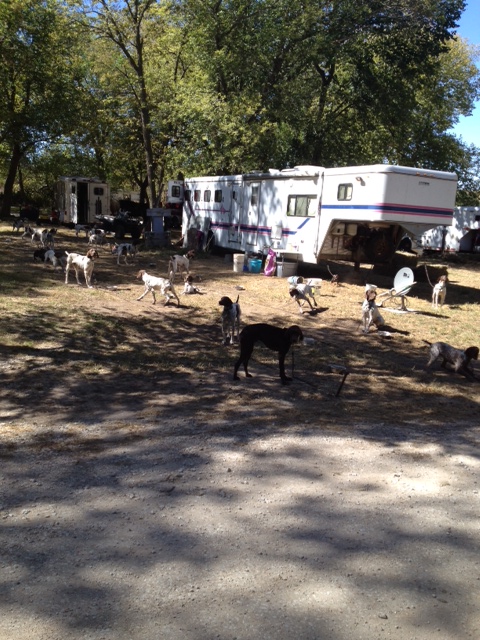
Following lunch at the hunt test and a good visit with friends and fellow local hunt test junkies, we loaded up and headed north to Branched Oak Field Trial Grounds near Raymond.  Although we had been there for hunt tests in the past, this field trial environment was completely different.  The German Shorthaired Pointer Club of Nebraska’s field trial over last weekend was four days long and had 235 entrants, making it one of the largest AKC field trials of the entire year.  Our “camp” was out in the back 40, so when the kids wanted to go to the clubhouse to get some sweets and sodas, we had to wade through the melee.  As most field trials are on horseback, most of the other camps consisted of a camper/horsetrailer/dogtrailer combo, a stakeout chain of 10-25 dogs and at least one horse.  Anytime someone walked down the dirt road in the midst of the gypsy village, all 235 dogs barked and spazzed out on their chains.  This was with the exception of BB of course, who really wanted her people very close to her in this strange setting.  I don’t think that any of us were comfortable and felt pretty alien: a family with small children and one griffon surrounded by herds of barking shorthairs, German Wirehaired Pointers and Vizsla dogs along with their owners who reminded me of the rodeo crowd; not sure if their faces are red from being sunburned or last night’s whiskey, or both.  The only time that I saw any other women is when they came out of their campers to water their dogs or smoke a cigarette.

A string of German Shorthaired Pointers at the AKC Field Trial on Saturday

Maybe I’m only drawing these caricatures because I was nervous and scared that my 3 year old was going to wade into a pack of freaked out hunting machines.  I don’t want to hurt any field trialer’s feelings and I’m sure we’ll be back for more, so I’ll get more comfortable and quit seeing things that make me want to point them out.  But as the hunt testing environment is where my fellow griffoniers find themselves, I wanted to point out the differences before anyone else decided to strike out into the field trial world.  Not that I have any serious ideas of other griffoniers going this route, as a few of them have raised questions about participation.

Our take on it is that Korthals wanted to breed a foot hunting dog that was faster than the bootlicking continental breeds of his time.  We do not believe that hunt testing does enough to test the athleticism and endurance of the animal, as it is a brief exercise that is only looking for the dog to satisfy the training requirements of the test (search, pointing, retrieving, steadiness, honoring etc.).  Even in NSTRA and BHU trials, the field is too small for it to be a valid test of athleticism.  We intend to continue to participate in walking stakes at AKC field trials and other trialers at the event encouraged Charles to look into American Field’s Region 19 events.

In my brief readings on American Field Region 19, these are events that last longer than an hour and are on open terrain and wild birds, which is a lot like what we are doing for hunting anyway, where we walk for at least an hour before stopping for water and usually two hours before we really stand or sit around for any lengthy period of time.  I would suspect that BB would be the first griffon to ever participate in American Field, should we decide to check it out.

BB placed 4th out of 5 in the Amateur Walking Derby stakes last Saturday, beating out a Vizsla her same age, working the terrain more thoroughly and having the one bird find of the run.  Although we are flying in the face of current convention with the breed, we worry more about the prevelance of designer house pets and conformation show-only dogs than about our involvement in walking stakes at field trials.  I really just wish we could channel the spirit of Korthals to ask him himself, but in the meantime we’ll just keep doing our research to support our methods and having fun with our dogs.

BB’s Fourth Place Ribbon.

Pupdates

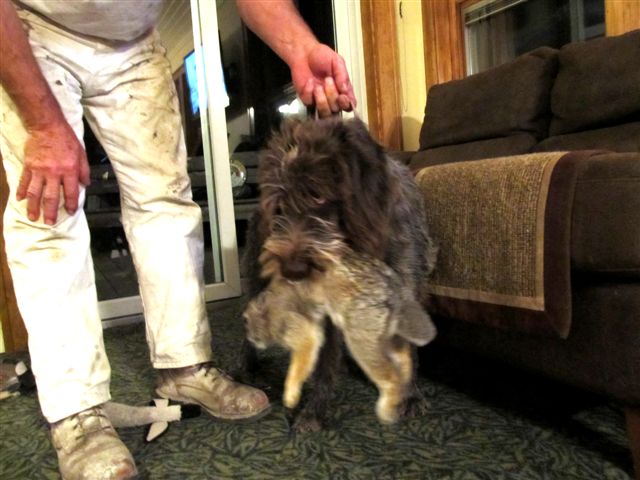
TracHer is busy as usual in North Dakota, she’s 7 months old now and been out on a few sharptail grouse and Hungarian Partridge hunts.  She’s even retrieved a few of them!  Most recently, she brought a live rabbit into the house through the doggie door while company was over, luckily they were fellow hunters!

TracHer on left (7 month old Wirehaired Pointing Griffon) with Susan and her old buddy Zephyr with Tom and their limit of sharptail grouse!

TracHer and her bunny (7 month old Wirehaired Pointing Griffon)

TracHer retrieving a sharptail grouse (7 month old Wirehaired Pointing Griffon)

Mike out in Colorado has also been working with TracHer’s “twin” sister Frankie on some pheasants.  He’s been working on steadiness on the point and he says she’s doing a great job!  Both TracHer and Frankie are from our 2012 “C” litter with Sam and Mae.

Mowgli is 18 months old and is from our 2011 “B” litter out of Sue and Sam.  Quite the looker!  I saw his brother Duke’s owner at the movie theater when I was taking the kids to see Finding Nemo 3-D, so hopefully I’ll get to see him soon.

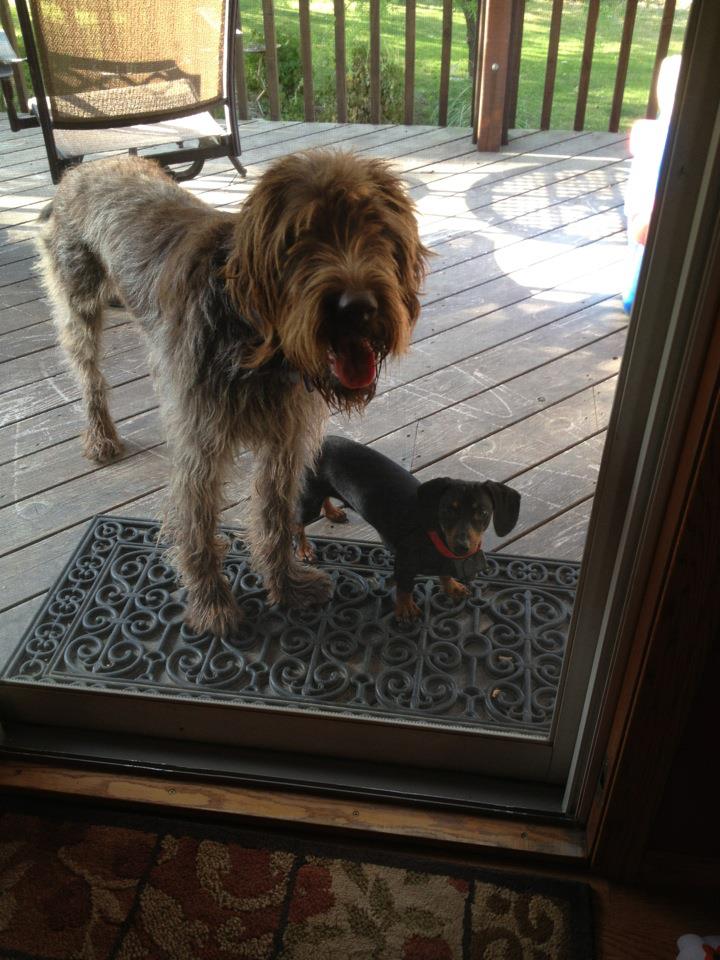
Mowgli (18 month old Wirehaired Pointing Griffon) and his neighbor friend the Dachshund chilling on the deck

Coming Soon to Versatile Hunter

Well in less than a week, we’ll be headed back out to the Sandhills for some more hunting.  There are no words for how terrible Eastern Nebraska has been this year thus far.  The swamps are too dry for early teal and snipe, then the prairie chicken grounds have all been mowed for hay.  Damn drought.  We are going to have to start commuting to not only the Sandhills, but the Rainwater Basin of Central Nebraska, the pheasant fields of South Dakota and Southwestern Nebraska as well as the quail fields of Kansas.  I hope that this is a temporary blip in the hunting situation in this part of the state because I don’t see us moving anytime soon.  But we are in fear of this being the beginning of a total collapse in hunting in Southeastern Nebraska.

Shirts!!

Oh and one last thing, be sure to check out the new t-shirt designs on our Shop!!  You can either click the button at the top of the page or go directly to http://www.wirehairedpointinggriffongear.com Buy a shirt to show your griffon pride, 100% made in the USA, from the shirt itself, the artists designs to the embroidery and screenprinting!!

No Deal on Early Teal

Leave a comment

On the opening Saturday of early teal season, Charles and Charity hustled the kids to the babysitter as soon as she would take them and headed to a friend’s pond to make their first attempt at sitting over decoys for the little ducks.  Sporting their hip boots and limited camouflage, they hauled their “dove buckets” (the camo-covered insulated 5 gallon buckets with the butt pad on the lid) over into a patch of sunflowers.

Charles and Sam sit in the sunflowers waiting for teal

The pond sits on the south shore of the Platte River, just a couple of miles west of the confluence with the mighty Missouri.  Their spot was on the southern end of the pond, with a little peninsula jutting northward out into the water, where Charles set up about five decoys on the point.  They sat on the western side of the peninsula, with their backs to the rising sun and another 5-10 decoys out in front of them.

They watched the big ducks and geese move along the Platte as the air grew warmer.  Canadian geese flew overhead.  Shots rang out along the river to the west of them, but they didn’t see any teal flush away from the sound of the reports.  A couple of mature bald eagles flew from the river and an immature perched in the tree above their heads, eyeing the decoys for awhile before moving on.  Charles worked his teal call every now and again, while his trusty retriever Sam laid next to the bucket, as still as he could be but nervous with excitement and attentive to his master’s every move.

The doves teased them, moving around in nearby trees and shrubs, but they sat patiently for the ducks.  A flock of turkeys came out of the woods on the north side of the pond to pick grit off of the beach, while a pair of wood ducks sat lazily in the pond nearby.  Herons and cormorants took their time moving from shore to shore, picking at little fish.

Then, like the Air Force Thunderbirds working an air show, a flock of 15 blue-winged teal flew fast and high over their heads.  “There they are,” whispered Charles, “don’t look at them!”  But it was too late, as Charity’s face and glasses were already pointed at the sky, watching the teal zoom out of range.  Charles worked the teal call a little as they watched the flock disappear into the distance, paying no mind to their feeble attempts at fooling them to land.  And as fast as it had begun, it had ended.  That was the action for the day, without a shot being fired.

They tried changing spots, moving into a tall patch of ragweed that made them both sneeze their heads off, but nothing made the little ducks appear again.

Charles has been back nearly every weekend day since, with no luck.  He was able to bring home a handful of doves and get Sam to tree a couple of coons, but no little ducks.  Recently, he’s been spending some time scouting the southern bank of the Platte river for an easy access point to get on to the sandbars, but it is a bit challenging since the southern side of the river typically has the main channel.  Pack up the canoe with layout blinds and head into the river to set up on some well established sandbars?

Sam’s double coon treeing

With snipe to be chased and big duck season coming on in a few weeks, time is running out on solving the early teal problem this fall, but you can bet it is something that they’ll think about and study for the next year and try some new tactics in 2013.

Nebraska Sandhills Opener 2012

1 Comment

The Nebraska Sandhills

Saturday, September 1, 2012

Charles, Charity and the dogs started opening day at the usual opening day spot, which is a half-mile wide, flat valley with a set of high dunes to the north, running east to west, and a set of shorter dunes to the south, also running east to west.  Charles was assigned the higher northern dune set and Charity the southern set.  This is the first year that they split up in 13 years of hunting together and will probably continue to hunt this way.  Charity’s pace is about half that of Charles’s, so the ability to determine their own speeds was the first reason.  The second reason is that running four dogs puts too much pressure on these skittish birds at once.  So, Charity took the older females, Mae and Sue, and Charles worked four year old male, Sam, and eighteen month old female, BB.

There are various ways to pattern a dunefield when hunting grouse, but Charity selected a straight up an ambling criss-cross pattern for opening day, starting on the southern, low dunes walking west to east, then turning back, walking a bit higher going east to west, then back again in the high chop going west to east.  It was in the high chop an hour after starting out that she flushed her first single sharptail just barely out of range, firing shots that didn’t connect.  A few steps later, a group of four got up at seventy five yards, flying off of the highest dune in the southern set, disappearing out of view to who knows where.  Despite being a bit ragged from each having a litter of pups this summer, Sue and Mae sprang into action once bird activity began.  They covered the highest dune to check for stragglers with no success and the descent down the eastern slope began at a frantic pace.  So frantic that both dogs and hunter marched right past the sharptail that cackled up behind Charity, so that she had to take the 200 degree shotgun swing for the double-barrel attempt.  She saw it wobble and descend, sending the dogs after a retrieve.  Sue happily retrieved the first grouse of the season for team Versatile Hunter and it was captured on her new head-mounted video camera.  http://www.youtube.com/watch?v=KBoTg3pINGk

Meanwhile, Charles was working the taller northern dunefield, also starting from the west and working his way east in a meandering zig-zag pattern, making sure that either he or the dogs were covering any possible grouse territory in the complex.  As he ascended into the target area, a random group of doves flushed off of a high dune and he couldn’t help himself but to harvest one.  Not long after he heard the reports of Charity’s missed shot and her success following shortly thereafter, he descended from a dune peak and looked down onto a small flat amongst the choppy hills.  Three grouse busted at seventy-five yards, as if they sensed something, but not necessarily imminent danger as they merely popped up and over the next slope.  As soon as he entered the marked zone of potential landing, one got up and he shot it at close range straight on, with BB nearby for a quick retrieve.

After Charity and the older females watched the cattle hustle off of the pond on the eastern end of the dunefield and head for the windmill a couple of miles to the northwest, they stopped for a water break before continuing their criss-cross pattern, back to the west on some of the lower dunes, then finally crossing back eastward on the flat right next to the dunes.  Charity has taken prairie chickens out of there in years past, but there was nothing to be seen this year.  Once she finishing fully covering her assigned area, she and the dogs crossed the valley to meet up with Charles to get the update of his one grouse and one dove in the bag, but he had more ground to cover and an idea where birds were in the high chop.  Charity followed the low dunes towards the west and stopped again at a windmill for a break, noting the lack of doves at the spot.

Charles headed northwest from the windmill into an extension of the same northern dunefield that he had been working all morning.  He marched his way to the extreme northwest corner and worked his way back and not soon after he reached the endpoint and began hiking back, the dogs got birdy and three grouse flushed within fifty yards, which is in range for Charles even with a twenty gauge.  He took one out of that group and while BB was on retrieve, another flushed even closer.  His shot merely clipped the wing and the bird began to run.  Luckily, catching running wounded birds is one of Sam’s specialties, so while BB was delivering the first bird, Sam put the lockdown on the attempted escapee to round out Charles’s limit for the day.

The sun was arcing higher into the azure sky and getting uncomfortably warm to continue trekking.  It was time to return to the truck, which Charity couldn’t see from the windmill but knew it was to the south.  She wandered a bit off track, farther east into the valley than she needed to go, but eventually caught sight of the vehicle and made it back just in time to meet up there with Charles.

At first they had it in their mind to sit for doves, but after scoping their two best spots and seeing nothing, they opted to sit out doves this trip and wait until their return to the Missouri River Valley, where they are plentiful this year.

Charles shows off his opening day limit back in town, with BB and Sam, Wirehaired Pointing Griffons

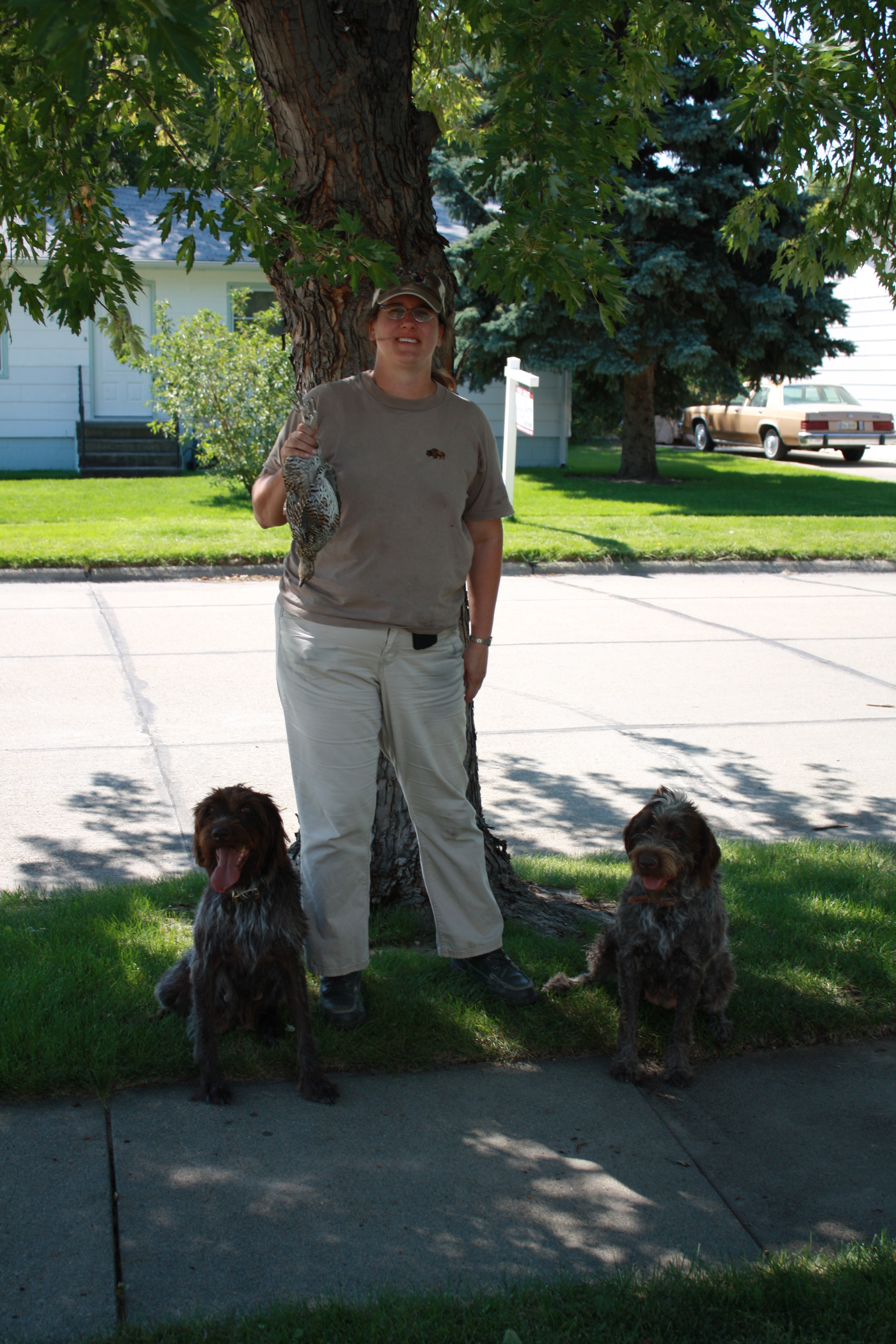
Charity is back in town with her first sharptail grouse of the year, assisted by Sue and Mae, Wirehaired Pointing Griffons

Sunday, September 2, 2012

Day two started early again this year, at the “big hill”, the one over by the “hard road”.  As there aren’t many landmarks to speak of in the sea of grass, they are forced to come up with their own for navigational purposes.  The valley between the two dunefields was much narrower than the previous day’s, only a few hundred yards, but it was a similar approach with Charles covering the northern side of the valley and Charity the southern.  Charity decided to use a figure eight pattern on this area, starting at the south and working eastward towards the middle of the dunes, using the highest peak as the centerpoint of the figure eight, then covering the north side of the dunes.  It took her an hour to cover the first curve of the figure eight, stopping at a windmill for a brief break, taking a couple of sips of water.  She then continued south, then turning westward to continue her figure eight pattern, back to the high dune as the centerpoint, then covering the north side, completing her figure eight.  In two hours of hiking, she didn’t even see a flush in the distance.

Charles took his normal approach into his assigned area and not long after starting to work it, he watched BB run over a dune out of sight and she didn’t check back in quickly like she normally would, so he headed in that direction.  Three or four grouse came sky charging away from where BB was last seen, straight towards Charles, with BB in hot pursuit.  In order to work on steadiness, Charles elected not to reward bad behavior and chose not to shoot.  He marked their likely landing zone back to the west and pursued.  Not five minutes later, the dogs started acting birdy and were tracking hard, but once again charged the flushing birds, so he opted out of shooting once again.  He did finally get a point out of BB, which is an anomaly in the dry Sandhills, as scenting conditions are basically nonexistent.  Charles “whoaed” Sam into honoring BB’s point, then began to kick around the hill trying to flush the birds.  But the wind was playing tricks and blowing the scent of a flock from the top of one dune a hundred yards away over to the top of the dune where the dogs were pointing, so the birds saw the motion and activity of Charles trying to find them and flushed way out of range.  As he stood at the top of the ridge, he heard the chortling of a large group of grouse over in a dune range that they had never hunted before.

Charity and Charles met up and headed back to the truck for a bit of a break.  Charles reported that he heard distant cackling coming from a north/south running set of dunes that they had never worked before, a half-mile across the valley, off to the west.  They decided to each take one end of the field, Charity to the south and Charles to the north, zig-zagging to meet in the middle.  Charity made it up and into the dunefield and her dogs found a group of three in a pocket of knee-high sumac.  She fired off a downhill shot, but the birds were just out of range.  As she headed off to take chase, she all of a sudden lost all energy, felt dizzy and her heart was racing.  All she could think was, “There is no way that Charles could find me, let alone drag me out of here and I’m not sure the truck could get up here.  I’ve got to get back down to the valley so that at least if I passed out he would be able to see me”.

Charles ascended the northern end of the new hunting grounds, just making the climb when seven or eight birds broke unexpectedly soon.  Most of them headed deep into the high chop, but others oddly enough headed for some trees on the edge of the dunes.  He made his way toward the trees, not usual sharptail grouse habitat, and sent the dogs in to run them out.  Sure enough the grouse came running scared out from the trees, then flushed as they came to the prairie edge at about fifty yards out.  A pellet found its way to a bird on the shot, but it wasn’t down for the count and sailed into the distance.  The bird knew it was in trouble and flushed again at fifty yards, but was hit hard this time and Sam had no problem bringing it in.

They marched higher into the chop, bumping a mule deer buck and a jackrabbit, but BB and Sam knew better than to chase those.  Not long after, three grouse got up, then a fourth was a bit slower on the jump that Charles put his bead on and harvested, with Sam once again delivered to hand.

Charity stumbled a few steps at a time back towards the east, sitting down frequently and feeling lucky when she heard Charles shooting just to the west of her, then him finally seeing her stumbling away from the hunt.  Her pride wouldn’t allow her to tell him that she was having trouble and was hoping that she would be able to shake off the spell and resume hunting.  But after a good 20 minutes of cramping and stumbling and feeling like Gumby, she accepted defeat and just wanted to get back to the truck.  Of course, that was when birds got up within her range, but even though she took shots, there was no way that she was focused enough to hit anything.

The birds that she missed raced right past Charles, well within range, but he too was feeling the effects of dehydration and was unable to focus on the task at hand.  With two in the bag and the day getting warmer, it was time to go.

They were both coming out of the dunefield at the same time, he with two in the bag and she just happy to have made it out without a medical incident.

Monday, September 3, 2012

As normal for day three, the alarm rang forty-five minutes later than the first two days.  Everyone dragged to the truck, sore and tired.  But luckily the fresh spot is full of birds and everyone loosened up with the excitement of immediate action.  This is a very wide dunefield and they elect to both travel east to west, with Charles to the south and Charity to the north.  Charity takes her first and only bird of the day within 10 minutes of leaving the truck.  The bird got up front and center, but she failed to disengage the safety at the first shot attempt, but then recovered in time to get a shot off as it veered over to her left.  She wasn’t sure if it connected, but swore she saw the bird waver as it topped the dune, so they headed back in the direction of the truck.  Mae found the bird and licked the blood and feathers, hesitating a bit on the retrieve.  She was called off of the bird and Sue was sent in.  The strong natural retrieve is Sue’s greatest gift.

Simultaneously, Charles enters his area, pushing another nice mule deer buck out of his resting place and hits the jackpot not long after, putting up a flock of 12 grouse, which was the only large group of the whole trip.  The birds head east, the opposite direction of our intended march, but birds don’t follow our puny human plans, now do they?  As he comes into the marked area where he thought they landed, the dogs loop to the west of the dune and he elects to go east, hoping to pin the wily critters down.  Out of nowhere, Sam starts barking, which is never a response to birds.  While Sam is barking his head off (which Charity could hear in the distance and was hoping everything was okay), a lone grouse flushes behind Charles that he quickly swings behind and kills, marking the bird down and leaving it lay to figure out the source of Sam’s anxiety.  Just as he turns back from the bird to look at Sam and his yucca problem, BB emerges from behind the plant with a face full of porcupine quills.  Charles pinned BB down and pulled out quills from her face and paw, while Sam continued his barking but learning the porky lesson long ago, Charles was confident Sam wouldn’t tangle with it.  Once he released BB from her operation, she immediately went and found the bird for the retrieve while Charles called Sam off of the barking spasm.

Charity continued west through the dunes, having a few groups of 3-4 get up both in and out of range within a span of a half hour, but the shots didn’t come together.  She spent another hour heading west towards a couple of windmills and a lone tree, but saw nothing.

The team of Charles, Sam and BB eased along the southern ridgeline that Charity had covered to the north and pushed birds into.  One got up that he missed, but a second bird jumped that he put a pellet into.  It soared a hundred yards away, but it was obviously hit because one leg was hanging limp despite its efforts to escape.  They worked over to where it was down and BB found and pointed it, but the bird hadn’t given up the fight.  It flushed again and with a close range going away shot, Charles had no problem bagging it.  They worked their way further into the area that Charity had busted up and a grouse charged them out of nowhere, flying up over a dune straight at them.  Needless to say, Charles’s limit was taken care of in that salvo.

Despite the remote location, they were within cell phone range and Charles texted that he had his limit and was coming to get her.  She made her way to the windmill by the lone tree and he drove the truck to pick her up, just in time to head back to town to fix the kids some lunch.

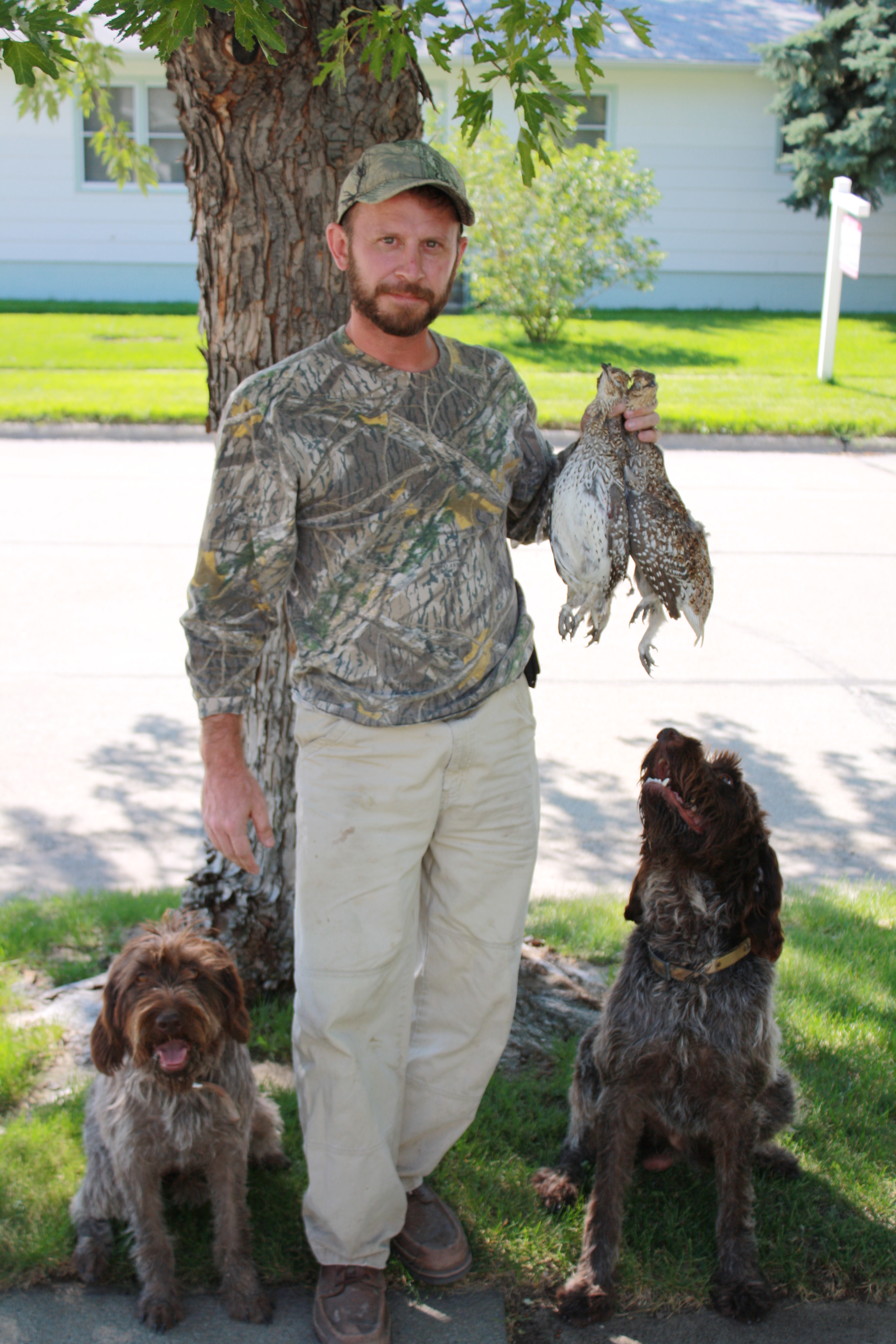
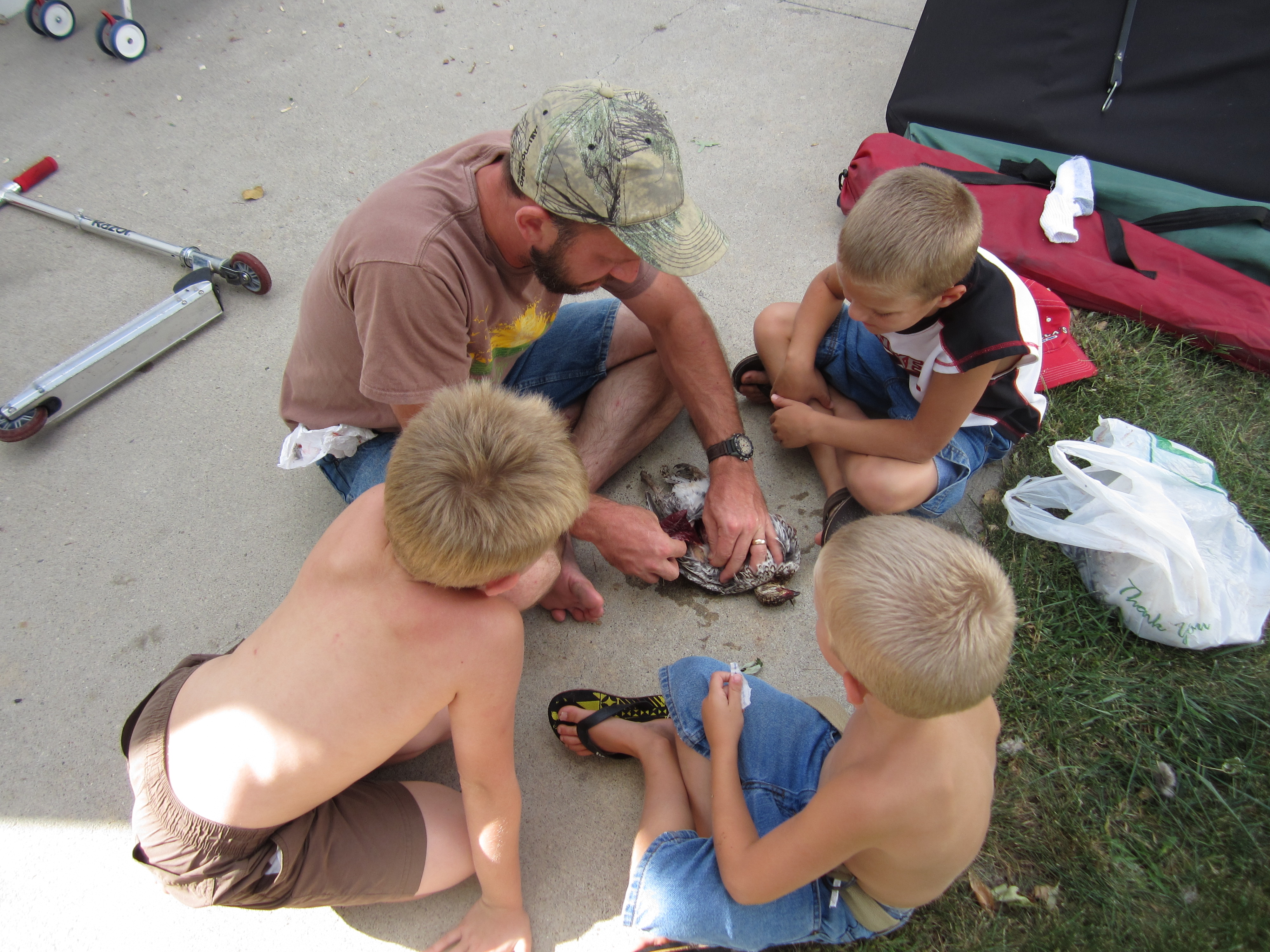
Charles shows the neighborhood boys, along with son, Conrad, on left, how to breast out a sharptail grouse

Tuesday, September 4, 2012

                As Charity’s family babysitting time had expired, plus there was make-up homework to help the kids with and laundry to do, Charles headed out to “Prairie Chicken Paradise” on his own.  He was making his way out to the paradise, in an area that used to surprise us when birds got up, but we’ve been surprised enough years to now know that a flock resides in these very low, almost nonexistent dunes on the way to our usual hunting grounds a mile and a half away from the road.  It was there that he took his only bird of the day, with unknown numbers jumping right into the sun, he instinctively fired at the sound of the wingbeats since he couldn’t see and was able to put one on the ground between him and Sam.

They made their way back to the deep dunefield that has consistently produced for us throughout the years, but not a flush was to be had.  BB began tracking hard, so since there seemed to be nothing else going on, Charles and Sam followed along.  BB was tracking a coyote, who jumped up and ran, but Charles was in no mood for fur and called the dogs off to head for home.  It was time to enjoy the company of our family and good friends in the Nebraska Sandhills.

Despite the long summer drought and unseasonably hot conditions, Charles, Charity and the dogs were able to have success on their traditional sharptail grouse and prairie chicken opener by relying on proven approaches to covering ground and relocating known coveys that they’ve hunted for over a decade.

Preparing the trip’s harvest for the freezer, minus 2 grouse that were already consumed.

BB’s AKC Field Trial: Amateur Walking Derby Stakes

Leave a comment

On Saturday, August 25th, Charles handled our 17 month old female pup, Bourg-Royal’s CB Bluestem JH NA 1, more commonly known as “BB” to a 3rd place finish in the Amateur Walking Derby stakes of the German Shorthaired Pointer Club of Nebraska’s AKC Field Trial at the Branched Oak Trial Grounds near Raymond, Nebraska.  We were in total shock.  Charles stayed for the placement announcement, but somehow didn’t hear (a bad case of shotgunner ear) that BB won third.  I was at the house and got a phone call from the trial grounds letting me know about it.  We had been texting all day while he was waiting for his run and his phone was dead on the drive home, so he didn’t find out until an hour and a half later when he got to town.

The amateur walking stakes setup is nearly identical to a hunt test. The dog works planted quail for 30 minutes braced with another dog. No live fire though, the handler shoots a starter pistol on the flush. Places are awarded instead of pass/fail. I’m still learning the specifics about how it is judged, but in general it is based on covering ground/desire to search and bird finds/points. I think BB had a lot of individual finds/points and also backed her bracemate on another point.

As all of the fellow competitors were either Vizslas or German Shorthaired Pointers, we were quite excited to show them the potential of a good griffon who can run.  The griffon will never range as wide as the big running dogs and that isn’t the point (ha, ha).  BB was able to outscore her competitors with bird finds and tractability.  BB’s bracemate ran like a bat out of hell and the owner spent most of his time trying to chase it down.  It blew past a number of birds that BB was able to locate because of her attentive nose and appropriate pacing.  There were only 7 dogs in the stakes, so the placement did not count for FC title points, but it was still the highlight of our weekend.  I’ve only been able to find one other griffon within the last 10 years who has placed in an AKC field trial (in online research) and I haven’t had a chance to talk to the AKC about the rarity of the event.

I wasn’t there to take live photos and we have no rosette to pose with yet (it’s in the mail), so I’ll have to just post a past photo of BB.  This is from her perfect score of 112 NAVHDA Natural Ability test in April.

Bourg-Royal's CB Bluestem JH NA 1, Wirehaired Pointing Griffon

Bourg-Royal’s CB Bluestem JH NA 1, Wirehaired Pointing Griffon

So, for my birthday and Christmas this year I got myself the GoPro Hero2 camera to wear hunting.  I should have enough battery and memory card power to just let it run all day (as long as I switch out the battery every 2 hours and the 32 GB memory card every 4), so it should be fun to watch me cuss, lose my breath, fall in coyote holes, miss easy shots and get lucky every once in awhile.  It does get a little heavy on your head, so I’m not sure if I’ll be able to convince Charles to try it, but I’m going to work on him.  I took the camera out to the pond with us on Sunday, but I was pressing all of the wrong buttons and got nothing, but the videos of the week are two unedited GoPro videos of Caleb and I walking the dogs (first Sam and Sue, then Mae and BB) in the back yard.  I should have edited them, but just really don’t have the time this week, sorry.  Part I with Sam and Sue: http://www.youtube.com/watch?v=Kbp7jhB2KCk  Part II with Mae and BB: http://www.youtube.com/watch?v=znd2BiO–14

Susan and Tom in North Dakota are always sending me great pictures of TracHer from our “C” litter earlier this year.  She’s coming up on 6 months of age and is working good on pointing and retrieving!

TracHer on point, 6 month old Wirehaired Pointing Griffon

TracHer looking pretty in the sunflowers, 6 month old Wirehaired Pointing Griffon

TracHer after she retrieved the goose Dokken, 6 month old Wirehaired Pointing Griffon

I also received an update from Rick who just lives on the other side of town with 3 month old Dottie from our “D” litter (the family liked her litter name so much that they just decided to keep it).  She is the star of the neighborhood and is on track with her growth, as well as work in the yard and field.

Dottie pointing the pheasant wing, 3 month old Wirehaired Pointing Griffon

It’s time to move on to filling out more AKC event premiums and packing for the big weekend grouse/prairie chicken and dove hunting trip.  It is supposed to be extremely hot, so we only see ourselves in the field for a few hours every morning.  I hope we’re able to capture some cool moments on film to share with you and we’re always good for some long-winded tales.  Wish us luck!

How to Groom a Wirehaired Pointing Griffon

4 Comments

A couple of years ago I wrote a post about grooming the Wirehaired Pointing Griffon and to this day it is one of my most visited.  As I’ve since learned more about the process, I wanted to provide my readers and others scouring the internet for information with my most up-to-date knowledge.

Most of my grooming comes out of necessity, as my property is wooded and contains burr bearing plants.  There are things that those grooming for show do that I don’t, which I’ll talk about at the end of my explanation.  My grooming is very utilitarian and only very infrequently for the show ring, but I will talk about show grooming techniques later on.

It is important to have good supplies.  I’ve acquired my collection of brushes, combs, scissors and other necessities over the years, but would think that starting out with a complete set and knowing how to use them would be helpful for a relatively new griffon owner.

Brushes and combs:  Multi-width metal comb, wide-toothed burr remover, undercoat comb, universal brush, slicker brush.  I also have a dog shampoo brush that I failed to include in my video, but it looks something like this: http://www.petsupplies.com/item/groomaster-rubber-brush-for-dogs/494975/

Shampoo:  For dogs under 6 months of age, I use a multi-purpose puppy shampoo of any brand.  Once they are over 6 months, I use Hartz Flea and Tick Dog Shampoo.  I do not recommend using the flea and tick shampoo within 2 weeks of having the dog’s coat evaluated, because it strips the oils from the coat. If you must wash the dog (like if it gets in the mud or something) within 2 weeks of going to a dog show or NAVHDA test where the dog’s coat is evaluated, use Bio-Groom Wire Coat Shampoo.  I have yet to try it out, but I do have a bottle and know the vast majority of griffon owners swear by it.  Due to my dogs spending so much time in the woods and field, I feel like I need to use the flea and tick shampoo in addition to my monthly flea and tick preventative regimen.

Ear cleaner:  My vet prescribes DermaPet Malacetic Otic solution, but any vet recommended ear cleaner should be purchased in the largest dispenser possible.

Scissors: I have a round-tip pair with a 1″ blade if I need to trim around their eyes (I don’t like hair blocking their vision), then a normal pair of round tipped shears for the body and ears and a pair of thinning shears for flattening out anywhere it is not level for the show ring.

I start out brushing the entire body of the dog with the wide-toothed burr remover, then repeat the process with the undercoat comb, then finish with the universal wire brush.  I just purchased a grooming table over the summer and am really enjoying it, saves me all of the bending over from when I used to brush them on the ground.

If the dog needs a bath, I then bathe them with one of the above listed shampoos, scrubbing them down with the rubber shampoo brush.  I’m in the process of creating a spot in my garage stall (that I’m slowly turning into a dog room) where I will have a dedicated grooming tub that is elevated, but as of right now my dogs are bathing in the kiddie pool in the summer and the human bath tub in the winter.

I then go through the process of cleaning my dog’s ears.  Holding the dog’s head still, fill the entire canal with the ear cleaning solution, put the ear flap down begin massaging the entire ear structure on the dogs skull vigorously for a few minutes.  They will shake out most of the excess.  You can either wipe out any excess and leftover dirt or simply let them drip dry.  Here is a video of me cleaning Sam’s ears: http://www.youtube.com/watch?v=pjgP6KNDfi8

That’s pretty much my basic regimen that keeps them clean and healthy.  If I’m going into the show ring, I will trim them after brushing and before bathing.  Please keep in mind that I’ve only started showing this year, but we did win Reserve Winners Bitch at our first major, so I must not have done too bad of a job.  Here is where I trim: probably the most important is leveling out the head furnishings.  Trim the hair at the bottom of the ears so that it is even, even out the head furnishings a bit, trim around the snout so that it is somewhat uniform and then level out a well combed out beard.  If the hair on top of the ears is not laying flat, use thinning shears to even it out to lay down.  Also make sure that the fur on the back of the head is under control, in order to accentuate the head furnishings.  Here is the photograph that I use for a guide (thank you to Paige Pettis of Pageska’s Griffon Town in Nova Scotia, Canada for use of the photo):

Two very handsome Wirehaired Pointing Griffons ready for the show ring in Quebec, Canada. Photo property of Paige Pettis

I then move on to make sure that the body hair is even.  Make sure that the feather on the back of the front legs is straight, trim any “sticky-outies” on their underside, trim the top of the tail if necessary and level out the feather at the bottom of the tail if you have a longer tailed griff like BB.  Here is the photograph that I use as a guide on the body (Thank you to Kristi Woods Rogney and her handler Amy Rutherford of Whiskeytown Sporting Dogs in California for use of the photo):

A Wirehaired Pointing Griffon ready for the California show circuit. Photo property of Kristi Woods Rogney

There are things that most griffon show groomers do that I do not due to our dogs spending most of their time in the field.  I do not finger strip, use a stripping stone, knife or furminator on my dogs’ coats.  Once you’ve seen a dog hunt cattails for a few hours, you’ll know why.  I do not pluck my dogs’ ears, so I end up cleaning them quite a bit.  My vet recommended not plucking them to make sure that field debris does not end up in the ear canal; I have a friend whose lab has his eardrum punctured by dried grass last year.  I have yet to learn how to clean my dogs’ teeth and right now rely on bones to keep them clean, but it is on my to-do list of things to learn (many folks have this done at their vet).  I do not trim my dogs’ claws because they get naturally worn down in daily exercise.  These are other things that you might want to think about and research elsewhere.

A little too much adventure…

Leave a comment

It was our second Sunday in a row for an all-pack walk, so we thought we would mix things up a little and try a different spot than normal.  This area is along the Missouri River, south of Plattsmouth, Nebraska.  Even though the road we were walking on is a good 1/2 to 3/4 of a mile from the Missouri (when it is cooperating with channelization) the area was completely submerged in about a foot or more of water all last summer.  So, even though we are in a drought this year and the vegetation is shorter than normal in most other places, due to the remnant moisture in the soil, the cover was 4-8 feet tall.

All was going well until a mile or so into the hike, when the 3 year old child decided he needed a break.  The road had ended anyhow and Charles and the dogs would have to wade through zero-visibility tall weeds for a half-mile or so to get to the river.  Here is a video of short clips of our hike up until the point of us stopping for a break, including some random shots of sunflowers at the end: http://www.youtube.com/watch?v=2s0jYVoPoeU

About a half hour or so later, Charles turned back up, sounding rather disgusted.  “Is BB with you?” he queried.  She wasn’t.  He hadn’t seen her since before he reached the river.  Given the fact that she ranges farther than the other three dogs and that it was pretty warm (probably 85, not heatwave hot), he thought that she had jumped in the river and gotten sucked downstream in the strong current.  My gut told me otherwise.  I’ve seen BB go for a long time without drinking and she is way more into running than swimming.  She’ll get out in the water if there is something to retrieve or if there are people or other dogs out, but I just couldn’t see her navigating the steep bank of the Missouri into the swiftly moving river.

Standing in the tall vegetation, we called and called and whistled for BB.  I kept the other three dogs and the kids at our spot in the shade, calling and whistling from where we were while Charles headed back down to the river calling for her.  20-30 minutes of calling and searching.  The vegetation was working against us and absorbing our noise.  We ran out of water and since we’d been in the field for over 2 hours and it was another mile hike back to the truck (which takes about 30 minutes with the kids), it was time to move.  We were hoping that maybe BB was back at the truck, but otherwise we’d replenish our water supplies and continue our search.  It was only 3 PM and we had another 6 hours until dark.

Caleb fell behind and wanted to take a break, playing in the dirt on the road next to a soybean field.  As the soybeans are only shin high and it was about a 20 acre field, I thought that this was probably my one chance to have my voice project and echo off of the nearby valley hills to the west.  I spent a good 5 to 10 minutes calling her name to the sky and whistling.  Looking back at Caleb playing in the dirt, I swore I saw a little reddish brown fur pop around the bend of the soybean field.  I ran over and thank God it was BB!  At first she was happy to see me, but then she got really “low dog” with her tail between her legs.  She knew she had been bad, meaning that most likely she got onto and chased a deer.

Every one of our dogs has had the experience as an older pup/younger dog of being overpowered by prey drive and the desire to run, chasing a deer, getting lost for a few hours, but then pulling their wits together and finding the pack.  It scares everyone, but is an important learning experience for the dog to keep checking back with the people.  This is an essential skill to keep Wirehaired Pointing Griffons as foot-hunting dogs and not just another out-of-control field trialing breed.

It felt good to be heading home together with all four Wirehaired Pointing Griffons we arrived with!

On the ride home, I found out that not only did BB have a misadventure, but when Charles came up on the Missouri, Sam piled in and swam about a third of the way out into the main channel, then realizing he needed to get back, tried to swim against the current to make his way back to shore, but was no match to the Mighty Mo.  Sam was sucked around a bend where Charles couldn’t see him.  The frightened owner ran the bank around the bend, calling for the dog.  The echo off of the other bank was confusing the dog, thinking that his boss was on the opposite bank.  Luckily Charles had Conrad’s blaze orange shirt in his hand, so he began waving Sam into the approaching wing dam.  Sam successfully made it to the calm upstream from the wing dam and climbed the rocks out of the churning channel.

That particular area is a bit too wild for all of us.  Maybe Charles with one dog can handle its peril, but the pack will stick to our usual spots.

In other news, I did receive a cute picture of Kyle and Jenna in Illinois, along with their puppy, Gomer, formerly known as “Darryl”.  They will be getting married soon and their pup will be their first baby (as was our first pup together):

Jenna and Kyle in Illinois with their 10 week old Wirehaired Pointing Griffon, Gomer, from our recent “D” litter

Susan and Tom in North Dakota sent over another great photo of TracHer on one of her first wild bird points, on sharptail grouse at 5  months old:

TracHer in North Dakota from our “C” litter on point, 5 month old Wirehaired Pointing Griffon

Sixteen more days until opening day of hunting season for us!  I plan on getting some videos made showing my grooming techniques this weekend to post for next week’s check-in, then it will be time to shift gears into the next phase of my writing year.  Thanks for coming along!

Pupdate: Homegoing!

Leave a comment

The last of the puppies went home on Saturday, August 4th.  There was a mad rush on Sunday, July 28th, three puppies went home in two hours!  Hence amidst that chaos, I forgot to take pictures of two out of three families.  Darryl went home to Illinois with Kyle and Jenna, who will be married in September.  Then David went home with Brian, Mindy and their two boys to south central Nebraska.  If you guys can send me pictures, I would greatly appreciate it!!

Dottie stays in the Omaha metro with Rick’s family

Doris will make her home in northwestern Iowa with Shane and family

Don went to northwestern Missouri with Dustin’s family

Daisy will live with Rob’s family in Illinois

Aaron’s family drove all the way from Ohio to collect Derry

The day before the puppies started going home, I worked with them individually on exposing them to a live quail: http://www.youtube.com/watch?v=URwusELauGw

Yesterday was spent devoting our attention to the adult dogs.  Charles has been working quite a bit with training BB and Sam for the AKC Senior Hunter test, but it had been a long while since all four dogs were out on a run.  So we loaded the kids and dogs up yesterday and marched them around.  Then we came back for a dog spa day, everyone was groomed and bathed.  Tonight Cordelia and I will take BB and Mae to conformation handling (dog show) practice.  It will be Mae’s first time practicing, so it should be interesting to see how it goes.

Of course, we are busy planning our hunting season, which begins in 25 days!

Good luck to all of the new owners with their puppies and do not hesitate to ask any questions if you have any!  I will be focused on writing about the basics of griffon care for the next couple of weeks and need to get Charles motivated to start posting on Versatile Hunter.

Here’s some cute pictures of TracHer in North Dakota, a puppy from our “C” litter earlier in the year.  Susan and Tom are doing such a great job with her!

TracHer with flowers, female Wirehaired Pointing Griffon at 4 months

TracHer on the training table, female Wirehaired Pointing Griffon at 5 months

Older Entries Newer Entries