Home

No Deal on Early Teal

Leave a comment

On the opening Saturday of early teal season, Charles and Charity hustled the kids to the babysitter as soon as she would take them and headed to a friend’s pond to make their first attempt at sitting over decoys for the little ducks.  Sporting their hip boots and limited camouflage, they hauled their “dove buckets” (the camo-covered insulated 5 gallon buckets with the butt pad on the lid) over into a patch of sunflowers.

Charles and Sam sit in the sunflowers waiting for teal

The pond sits on the south shore of the Platte River, just a couple of miles west of the confluence with the mighty Missouri.  Their spot was on the southern end of the pond, with a little peninsula jutting northward out into the water, where Charles set up about five decoys on the point.  They sat on the western side of the peninsula, with their backs to the rising sun and another 5-10 decoys out in front of them.

They watched the big ducks and geese move along the Platte as the air grew warmer.  Canadian geese flew overhead.  Shots rang out along the river to the west of them, but they didn’t see any teal flush away from the sound of the reports.  A couple of mature bald eagles flew from the river and an immature perched in the tree above their heads, eyeing the decoys for awhile before moving on.  Charles worked his teal call every now and again, while his trusty retriever Sam laid next to the bucket, as still as he could be but nervous with excitement and attentive to his master’s every move.

The doves teased them, moving around in nearby trees and shrubs, but they sat patiently for the ducks.  A flock of turkeys came out of the woods on the north side of the pond to pick grit off of the beach, while a pair of wood ducks sat lazily in the pond nearby.  Herons and cormorants took their time moving from shore to shore, picking at little fish.

Then, like the Air Force Thunderbirds working an air show, a flock of 15 blue-winged teal flew fast and high over their heads.  “There they are,” whispered Charles, “don’t look at them!”  But it was too late, as Charity’s face and glasses were already pointed at the sky, watching the teal zoom out of range.  Charles worked the teal call a little as they watched the flock disappear into the distance, paying no mind to their feeble attempts at fooling them to land.  And as fast as it had begun, it had ended.  That was the action for the day, without a shot being fired.

They tried changing spots, moving into a tall patch of ragweed that made them both sneeze their heads off, but nothing made the little ducks appear again.

Charles has been back nearly every weekend day since, with no luck.  He was able to bring home a handful of doves and get Sam to tree a couple of coons, but no little ducks.  Recently, he’s been spending some time scouting the southern bank of the Platte river for an easy access point to get on to the sandbars, but it is a bit challenging since the southern side of the river typically has the main channel.  Pack up the canoe with layout blinds and head into the river to set up on some well established sandbars?

Sam’s double coon treeing

With snipe to be chased and big duck season coming on in a few weeks, time is running out on solving the early teal problem this fall, but you can bet it is something that they’ll think about and study for the next year and try some new tactics in 2013.

Nebraska Sandhills Opener 2012

1 Comment

The Nebraska Sandhills

Saturday, September 1, 2012

Charles, Charity and the dogs started opening day at the usual opening day spot, which is a half-mile wide, flat valley with a set of high dunes to the north, running east to west, and a set of shorter dunes to the south, also running east to west.  Charles was assigned the higher northern dune set and Charity the southern set.  This is the first year that they split up in 13 years of hunting together and will probably continue to hunt this way.  Charity’s pace is about half that of Charles’s, so the ability to determine their own speeds was the first reason.  The second reason is that running four dogs puts too much pressure on these skittish birds at once.  So, Charity took the older females, Mae and Sue, and Charles worked four year old male, Sam, and eighteen month old female, BB.

There are various ways to pattern a dunefield when hunting grouse, but Charity selected a straight up an ambling criss-cross pattern for opening day, starting on the southern, low dunes walking west to east, then turning back, walking a bit higher going east to west, then back again in the high chop going west to east.  It was in the high chop an hour after starting out that she flushed her first single sharptail just barely out of range, firing shots that didn’t connect.  A few steps later, a group of four got up at seventy five yards, flying off of the highest dune in the southern set, disappearing out of view to who knows where.  Despite being a bit ragged from each having a litter of pups this summer, Sue and Mae sprang into action once bird activity began.  They covered the highest dune to check for stragglers with no success and the descent down the eastern slope began at a frantic pace.  So frantic that both dogs and hunter marched right past the sharptail that cackled up behind Charity, so that she had to take the 200 degree shotgun swing for the double-barrel attempt.  She saw it wobble and descend, sending the dogs after a retrieve.  Sue happily retrieved the first grouse of the season for team Versatile Hunter and it was captured on her new head-mounted video camera.  http://www.youtube.com/watch?v=KBoTg3pINGk

Meanwhile, Charles was working the taller northern dunefield, also starting from the west and working his way east in a meandering zig-zag pattern, making sure that either he or the dogs were covering any possible grouse territory in the complex.  As he ascended into the target area, a random group of doves flushed off of a high dune and he couldn’t help himself but to harvest one.  Not long after he heard the reports of Charity’s missed shot and her success following shortly thereafter, he descended from a dune peak and looked down onto a small flat amongst the choppy hills.  Three grouse busted at seventy-five yards, as if they sensed something, but not necessarily imminent danger as they merely popped up and over the next slope.  As soon as he entered the marked zone of potential landing, one got up and he shot it at close range straight on, with BB nearby for a quick retrieve.

After Charity and the older females watched the cattle hustle off of the pond on the eastern end of the dunefield and head for the windmill a couple of miles to the northwest, they stopped for a water break before continuing their criss-cross pattern, back to the west on some of the lower dunes, then finally crossing back eastward on the flat right next to the dunes.  Charity has taken prairie chickens out of there in years past, but there was nothing to be seen this year.  Once she finishing fully covering her assigned area, she and the dogs crossed the valley to meet up with Charles to get the update of his one grouse and one dove in the bag, but he had more ground to cover and an idea where birds were in the high chop.  Charity followed the low dunes towards the west and stopped again at a windmill for a break, noting the lack of doves at the spot.

Charles headed northwest from the windmill into an extension of the same northern dunefield that he had been working all morning.  He marched his way to the extreme northwest corner and worked his way back and not soon after he reached the endpoint and began hiking back, the dogs got birdy and three grouse flushed within fifty yards, which is in range for Charles even with a twenty gauge.  He took one out of that group and while BB was on retrieve, another flushed even closer.  His shot merely clipped the wing and the bird began to run.  Luckily, catching running wounded birds is one of Sam’s specialties, so while BB was delivering the first bird, Sam put the lockdown on the attempted escapee to round out Charles’s limit for the day.

The sun was arcing higher into the azure sky and getting uncomfortably warm to continue trekking.  It was time to return to the truck, which Charity couldn’t see from the windmill but knew it was to the south.  She wandered a bit off track, farther east into the valley than she needed to go, but eventually caught sight of the vehicle and made it back just in time to meet up there with Charles.

At first they had it in their mind to sit for doves, but after scoping their two best spots and seeing nothing, they opted to sit out doves this trip and wait until their return to the Missouri River Valley, where they are plentiful this year.
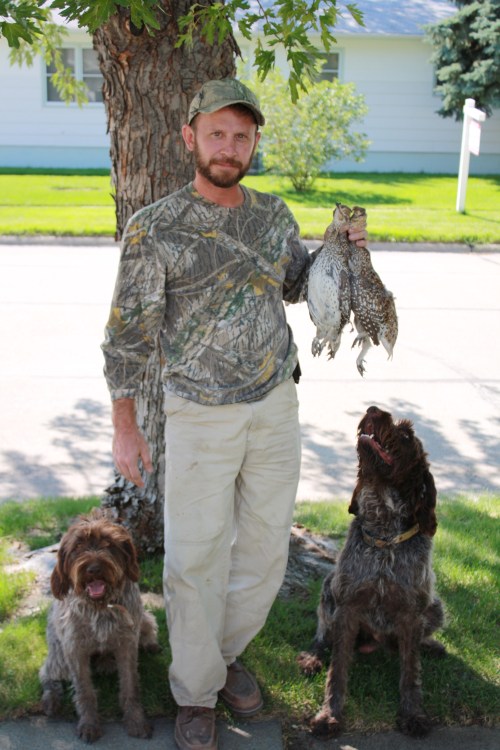
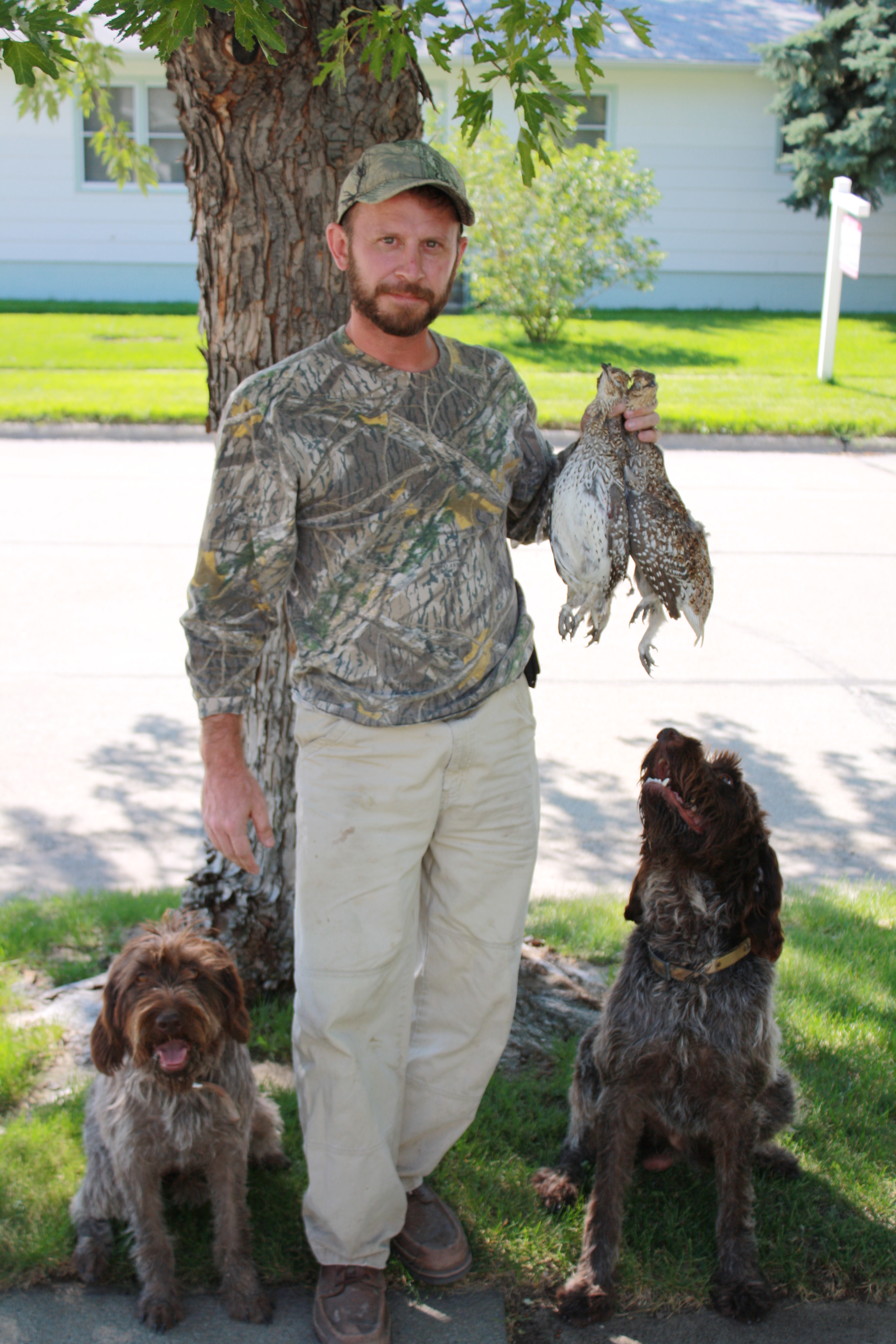
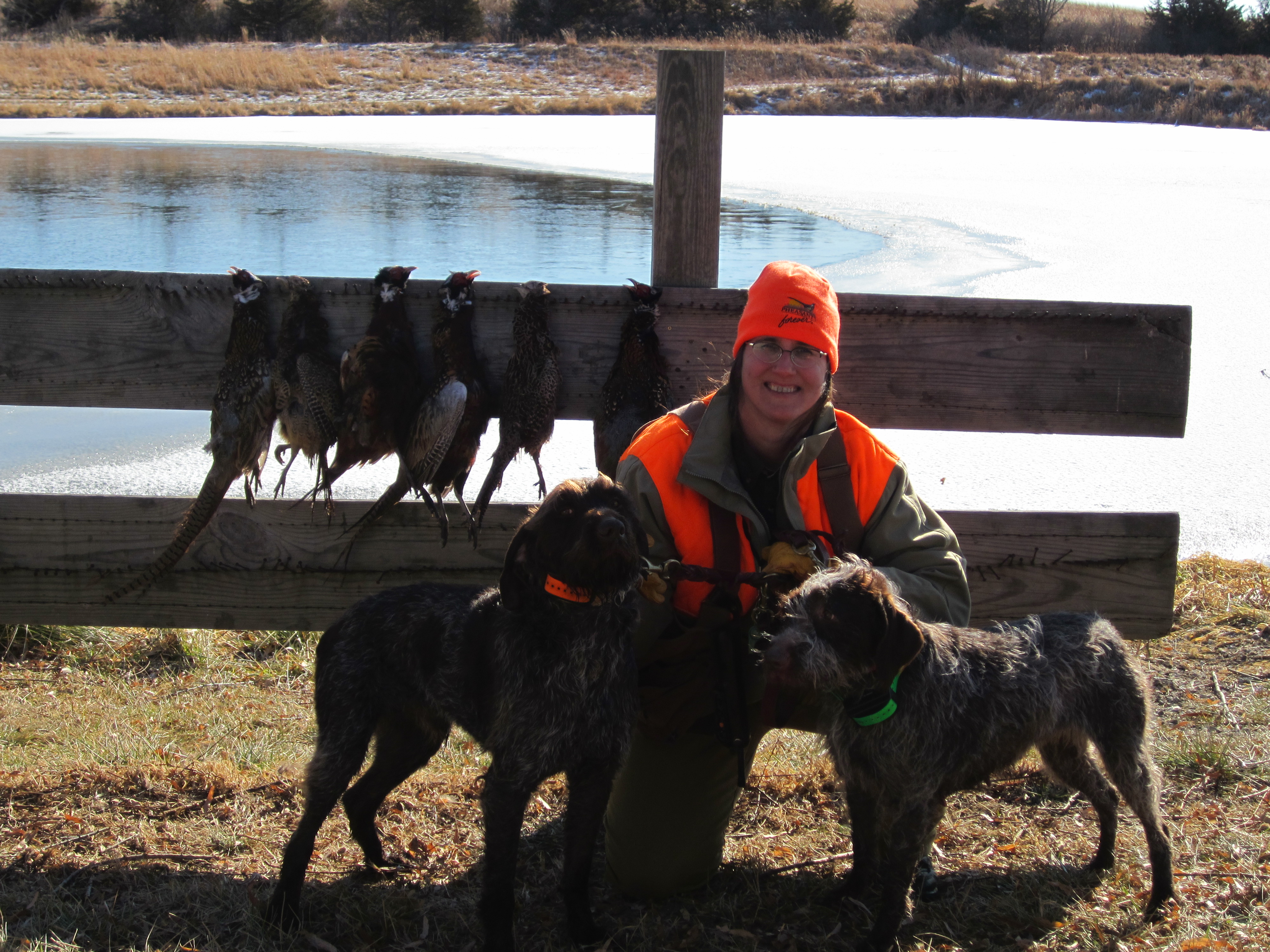
Charles shows off his opening day limit back in town, with BB and Sam, Wirehaired Pointing Griffons

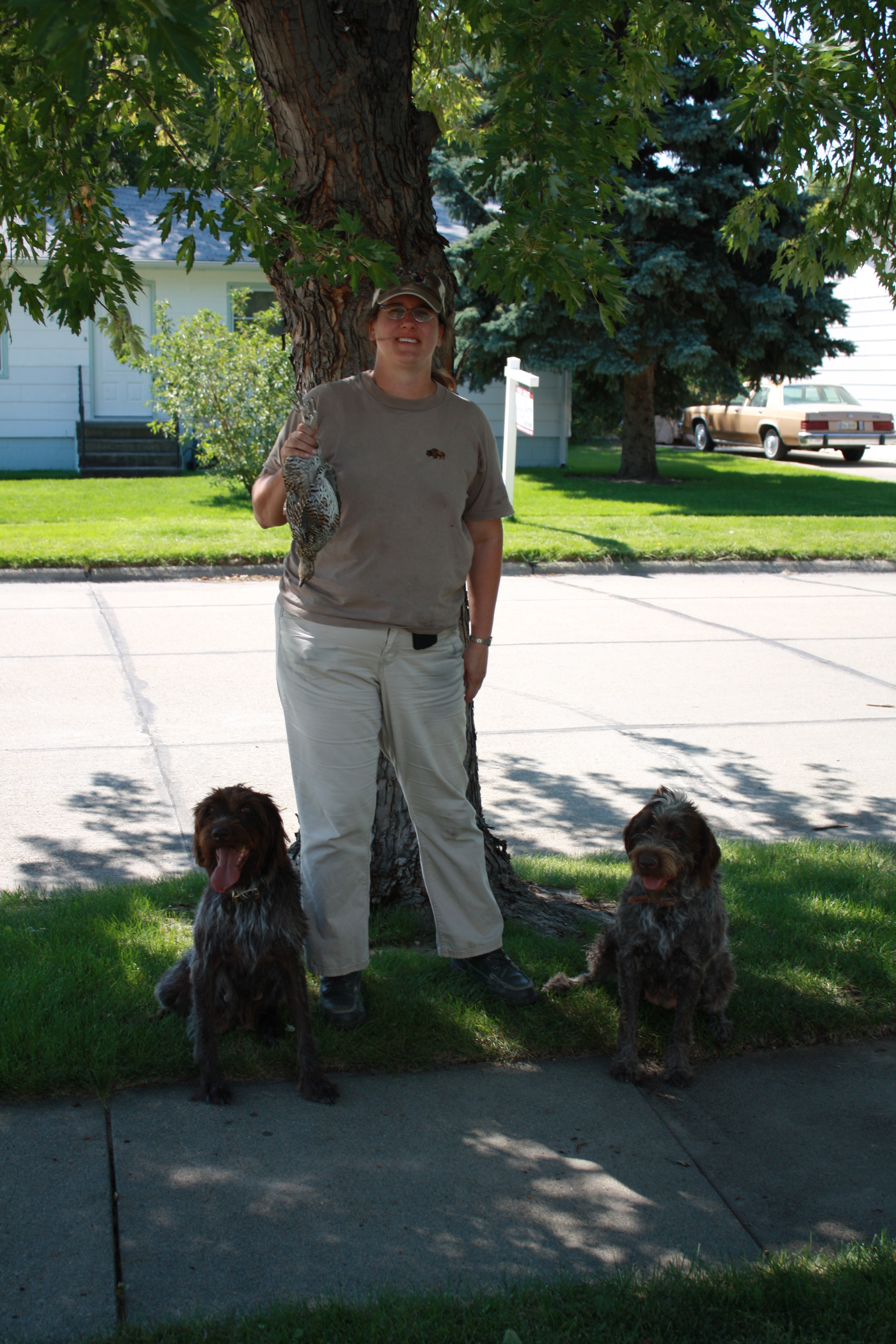
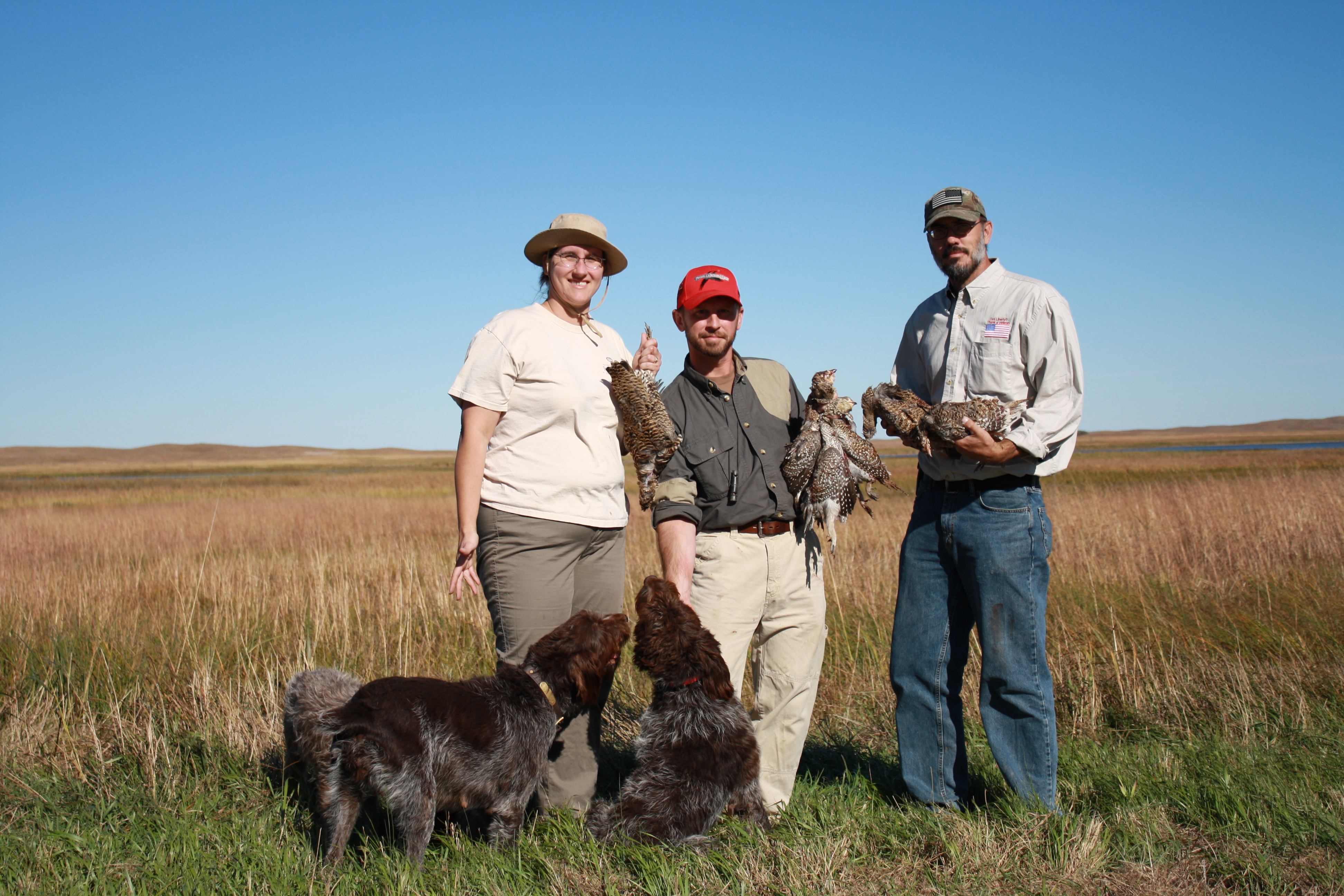
Charity is back in town with her first sharptail grouse of the year, assisted by Sue and Mae, Wirehaired Pointing Griffons

Sunday, September 2, 2012

Day two started early again this year, at the “big hill”, the one over by the “hard road”.  As there aren’t many landmarks to speak of in the sea of grass, they are forced to come up with their own for navigational purposes.  The valley between the two dunefields was much narrower than the previous day’s, only a few hundred yards, but it was a similar approach with Charles covering the northern side of the valley and Charity the southern.  Charity decided to use a figure eight pattern on this area, starting at the south and working eastward towards the middle of the dunes, using the highest peak as the centerpoint of the figure eight, then covering the north side of the dunes.  It took her an hour to cover the first curve of the figure eight, stopping at a windmill for a brief break, taking a couple of sips of water.  She then continued south, then turning westward to continue her figure eight pattern, back to the high dune as the centerpoint, then covering the north side, completing her figure eight.  In two hours of hiking, she didn’t even see a flush in the distance.

Charles took his normal approach into his assigned area and not long after starting to work it, he watched BB run over a dune out of sight and she didn’t check back in quickly like she normally would, so he headed in that direction.  Three or four grouse came sky charging away from where BB was last seen, straight towards Charles, with BB in hot pursuit.  In order to work on steadiness, Charles elected not to reward bad behavior and chose not to shoot.  He marked their likely landing zone back to the west and pursued.  Not five minutes later, the dogs started acting birdy and were tracking hard, but once again charged the flushing birds, so he opted out of shooting once again.  He did finally get a point out of BB, which is an anomaly in the dry Sandhills, as scenting conditions are basically nonexistent.  Charles “whoaed” Sam into honoring BB’s point, then began to kick around the hill trying to flush the birds.  But the wind was playing tricks and blowing the scent of a flock from the top of one dune a hundred yards away over to the top of the dune where the dogs were pointing, so the birds saw the motion and activity of Charles trying to find them and flushed way out of range.  As he stood at the top of the ridge, he heard the chortling of a large group of grouse over in a dune range that they had never hunted before.

Charity and Charles met up and headed back to the truck for a bit of a break.  Charles reported that he heard distant cackling coming from a north/south running set of dunes that they had never worked before, a half-mile across the valley, off to the west.  They decided to each take one end of the field, Charity to the south and Charles to the north, zig-zagging to meet in the middle.  Charity made it up and into the dunefield and her dogs found a group of three in a pocket of knee-high sumac.  She fired off a downhill shot, but the birds were just out of range.  As she headed off to take chase, she all of a sudden lost all energy, felt dizzy and her heart was racing.  All she could think was, “There is no way that Charles could find me, let alone drag me out of here and I’m not sure the truck could get up here.  I’ve got to get back down to the valley so that at least if I passed out he would be able to see me”.

Charles ascended the northern end of the new hunting grounds, just making the climb when seven or eight birds broke unexpectedly soon.  Most of them headed deep into the high chop, but others oddly enough headed for some trees on the edge of the dunes.  He made his way toward the trees, not usual sharptail grouse habitat, and sent the dogs in to run them out.  Sure enough the grouse came running scared out from the trees, then flushed as they came to the prairie edge at about fifty yards out.  A pellet found its way to a bird on the shot, but it wasn’t down for the count and sailed into the distance.  The bird knew it was in trouble and flushed again at fifty yards, but was hit hard this time and Sam had no problem bringing it in.

They marched higher into the chop, bumping a mule deer buck and a jackrabbit, but BB and Sam knew better than to chase those.  Not long after, three grouse got up, then a fourth was a bit slower on the jump that Charles put his bead on and harvested, with Sam once again delivered to hand.

Charity stumbled a few steps at a time back towards the east, sitting down frequently and feeling lucky when she heard Charles shooting just to the west of her, then him finally seeing her stumbling away from the hunt.  Her pride wouldn’t allow her to tell him that she was having trouble and was hoping that she would be able to shake off the spell and resume hunting.  But after a good 20 minutes of cramping and stumbling and feeling like Gumby, she accepted defeat and just wanted to get back to the truck.  Of course, that was when birds got up within her range, but even though she took shots, there was no way that she was focused enough to hit anything.

The birds that she missed raced right past Charles, well within range, but he too was feeling the effects of dehydration and was unable to focus on the task at hand.  With two in the bag and the day getting warmer, it was time to go.

They were both coming out of the dunefield at the same time, he with two in the bag and she just happy to have made it out without a medical incident.

Monday, September 3, 2012

As normal for day three, the alarm rang forty-five minutes later than the first two days.  Everyone dragged to the truck, sore and tired.  But luckily the fresh spot is full of birds and everyone loosened up with the excitement of immediate action.  This is a very wide dunefield and they elect to both travel east to west, with Charles to the south and Charity to the north.  Charity takes her first and only bird of the day within 10 minutes of leaving the truck.  The bird got up front and center, but she failed to disengage the safety at the first shot attempt, but then recovered in time to get a shot off as it veered over to her left.  She wasn’t sure if it connected, but swore she saw the bird waver as it topped the dune, so they headed back in the direction of the truck.  Mae found the bird and licked the blood and feathers, hesitating a bit on the retrieve.  She was called off of the bird and Sue was sent in.  The strong natural retrieve is Sue’s greatest gift.

Simultaneously, Charles enters his area, pushing another nice mule deer buck out of his resting place and hits the jackpot not long after, putting up a flock of 12 grouse, which was the only large group of the whole trip.  The birds head east, the opposite direction of our intended march, but birds don’t follow our puny human plans, now do they?  As he comes into the marked area where he thought they landed, the dogs loop to the west of the dune and he elects to go east, hoping to pin the wily critters down.  Out of nowhere, Sam starts barking, which is never a response to birds.  While Sam is barking his head off (which Charity could hear in the distance and was hoping everything was okay), a lone grouse flushes behind Charles that he quickly swings behind and kills, marking the bird down and leaving it lay to figure out the source of Sam’s anxiety.  Just as he turns back from the bird to look at Sam and his yucca problem, BB emerges from behind the plant with a face full of porcupine quills.  Charles pinned BB down and pulled out quills from her face and paw, while Sam continued his barking but learning the porky lesson long ago, Charles was confident Sam wouldn’t tangle with it.  Once he released BB from her operation, she immediately went and found the bird for the retrieve while Charles called Sam off of the barking spasm.

Charity continued west through the dunes, having a few groups of 3-4 get up both in and out of range within a span of a half hour, but the shots didn’t come together.  She spent another hour heading west towards a couple of windmills and a lone tree, but saw nothing.

The team of Charles, Sam and BB eased along the southern ridgeline that Charity had covered to the north and pushed birds into.  One got up that he missed, but a second bird jumped that he put a pellet into.  It soared a hundred yards away, but it was obviously hit because one leg was hanging limp despite its efforts to escape.  They worked over to where it was down and BB found and pointed it, but the bird hadn’t given up the fight.  It flushed again and with a close range going away shot, Charles had no problem bagging it.  They worked their way further into the area that Charity had busted up and a grouse charged them out of nowhere, flying up over a dune straight at them.  Needless to say, Charles’s limit was taken care of in that salvo.

Despite the remote location, they were within cell phone range and Charles texted that he had his limit and was coming to get her.  She made her way to the windmill by the lone tree and he drove the truck to pick her up, just in time to head back to town to fix the kids some lunch.
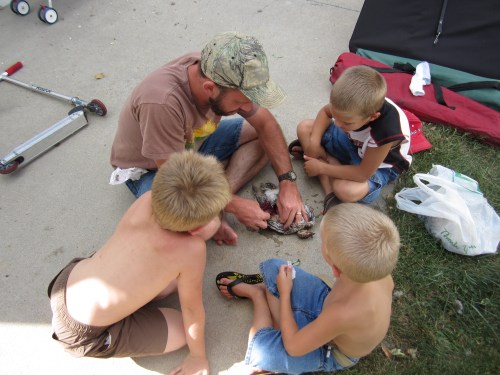
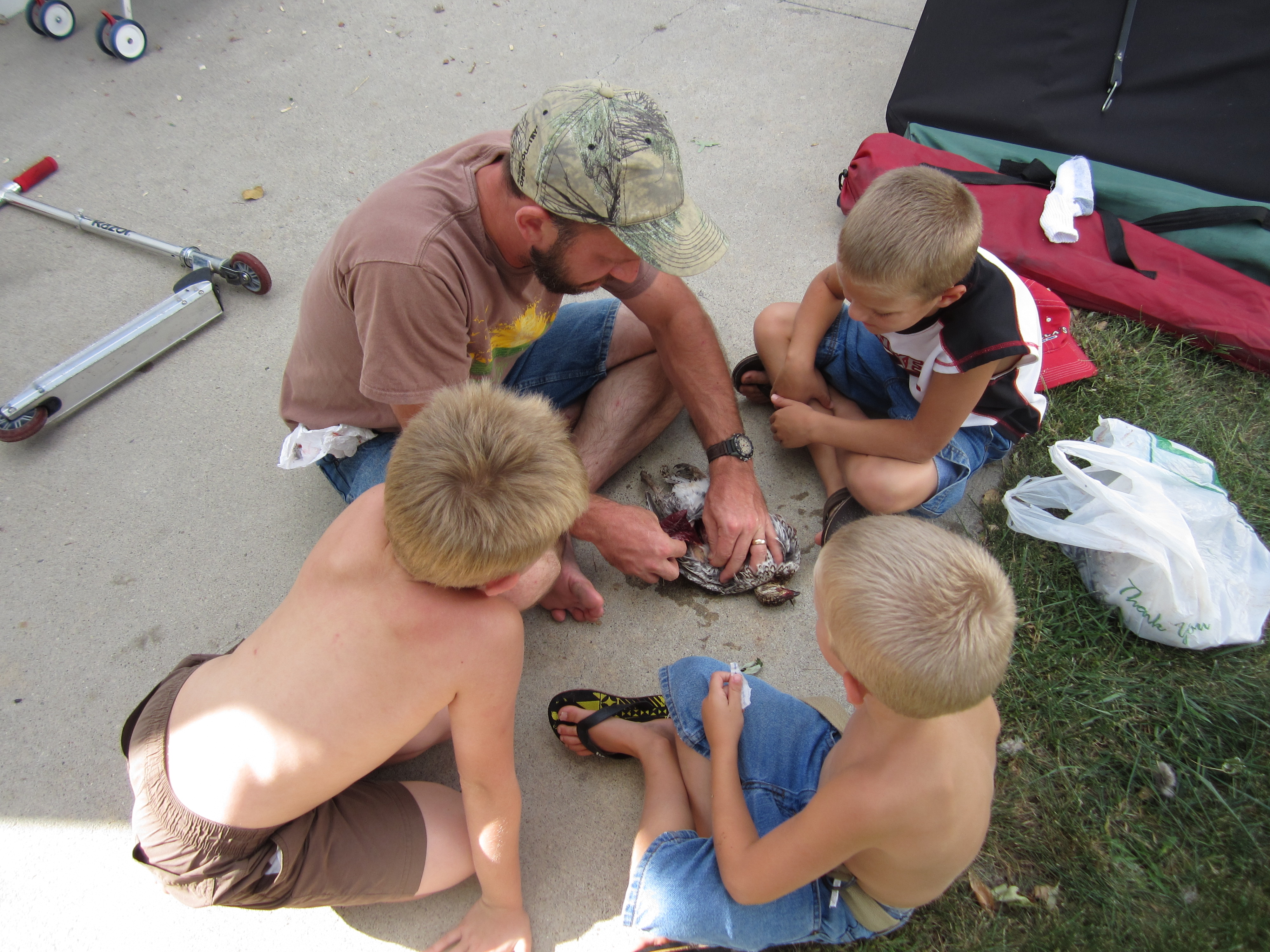
Charles shows the neighborhood boys, along with son, Conrad, on left, how to breast out a sharptail grouse

Tuesday, September 4, 2012

                As Charity’s family babysitting time had expired, plus there was make-up homework to help the kids with and laundry to do, Charles headed out to “Prairie Chicken Paradise” on his own.  He was making his way out to the paradise, in an area that used to surprise us when birds got up, but we’ve been surprised enough years to now know that a flock resides in these very low, almost nonexistent dunes on the way to our usual hunting grounds a mile and a half away from the road.  It was there that he took his only bird of the day, with unknown numbers jumping right into the sun, he instinctively fired at the sound of the wingbeats since he couldn’t see and was able to put one on the ground between him and Sam.

They made their way back to the deep dunefield that has consistently produced for us throughout the years, but not a flush was to be had.  BB began tracking hard, so since there seemed to be nothing else going on, Charles and Sam followed along.  BB was tracking a coyote, who jumped up and ran, but Charles was in no mood for fur and called the dogs off to head for home.  It was time to enjoy the company of our family and good friends in the Nebraska Sandhills.

Despite the long summer drought and unseasonably hot conditions, Charles, Charity and the dogs were able to have success on their traditional sharptail grouse and prairie chicken opener by relying on proven approaches to covering ground and relocating known coveys that they’ve hunted for over a decade.

Preparing the trip’s harvest for the freezer, minus 2 grouse that were already consumed.

Use Enough Gun and Watch Where You Aim That Thing

2 Comments

Robert Ruark knew what he was talking about when wrote the seminal piece on big-game hunting in Africa, Use Enough Gun.  Sure, you can kill tough game with light rounds, but if you want to consistently be successful in difficult situations, you need to use enough gun in order to get the job done.

While late season birdhunting in pheasant country isn’t the same as stalking the plains of Tanzania, it is a demanding business.  Roosters are well educated and aren’t going to wait around to see if quartering dogs and approaching humans are out for stroll, they are going to run and break long.  These birds are up early and rarely relax on the roost 30 minutes after sunrise unless the weather is foul.  And by foul, I mean bone chilling cold with snow piled around them .  I know this, but for some reason I thought I would be clever on my January 16th outing and carry a 20 gauge.  The allure of carrying a gun that is light, some decent shooting during the season on my part and the fact that we were heading into country where we were more likely to see quail than pheasant convinced me that I could get by without my trusty SKB 12 gauge.  That decision might have also been influenced by 2 days of heavy labor digging out a terrace for a new dog kennel .  Sore shoulders can certainly sing a siren song.

Whatever my motivations might have been, the decision was made and I headed out early with 2 griffs and a great birdhunting partner. As we approached the area we were going to push first, a covey of quail scurried across the ditch. I patted myself on the back for having the foresight to save my sore arms the trouble of carrying the 12 gauge.

We started in a CRP field bordering a cut corn field.  Definitely a promising spot for birds.  The dogs went to work, but it was obvious early on that they were on a pheasant.  They moved quickly and pushed hard through a patch of sunflower that had to be 10 feet tall.  No covey on the planet moves like a rooster looking to see what is happening on the other side of the county.  My partner and I kept pace and as we approached the end of the field a big gaudy ditch chicken broke out past the 40 yard mark.  It is amazing how such a big bird can blast out of heavy cover and move when he has a reason.  Needless to say, this crossing shot was not to be had.  By the time I gathered myself for the shot, he was moving at top speed and 50 yards away.  Undergunned for that one.  With that defeat under our belts, Matt and I headed to the next field.

The next field was considerable larger and we worked the edges where the CRP met the corn.  While the dogs covered ground and indicated that birds had been there, nothing was seen.  As we came to the end of the field we made the determination that this place was vacated.  This was public land and there was every reason to believe that we were too late.  Well, you know what they say about assumptions.  With no birds and no birdy dogs, I decided to add to the soil’s moisture profile.  About the time I was ready to commence relief, my partner’s shotgun barked and a lone quail sailed onto the bordering private ground.  Quickly I collected myself and walked over to him.  “Did you see any others?” I asked.

“Nope,” he responded.  We stood there a few minutes scratching our heads.  I call the dogs over but they didn’t really hit on anything.  Now the wind was against us and it was a dry morning, so I’ll give them a pass.  But as I stepped into the brush and resumed my efforts at irrigation, that lone quail’s covey mates boiled up around me just when I was really getting going.  Guess I need to be more careful where I aim that thing.

With the shotgun broken over my shoulder and the fact that I was a bit exposed, my chance at a shot was handicapped to say the least.  Missed again and this time my red face had less to do with my shooting than it did with my particular position for the shot.   We moved on to the next field.   These birds had been traumatized enough.

The following spot we hit was less promising, but there was a brushy creek weaving through corn, so it couldn’t be passed up.  As we shuffled along, I noticed a little finger of cover weaving up an old waterway in the middle of the corn. Matt and I changed course and the dogs closed in on it.  Immediately Sam locked up on the one spot of brush in this patch.  BB came up behind him and locked up as well.  Matt and I closed in quickly.  As if out of a hunting show, we walked in on the point and a nice covey broke.  This time everything worked out and I made a nice shot on a bobwhite.  The covey headed for thick cover and we followed.  We put up a few more, but they were in thick enough stuff that neither of us a shot.

Quail and Wirehaired Pointing Griffons

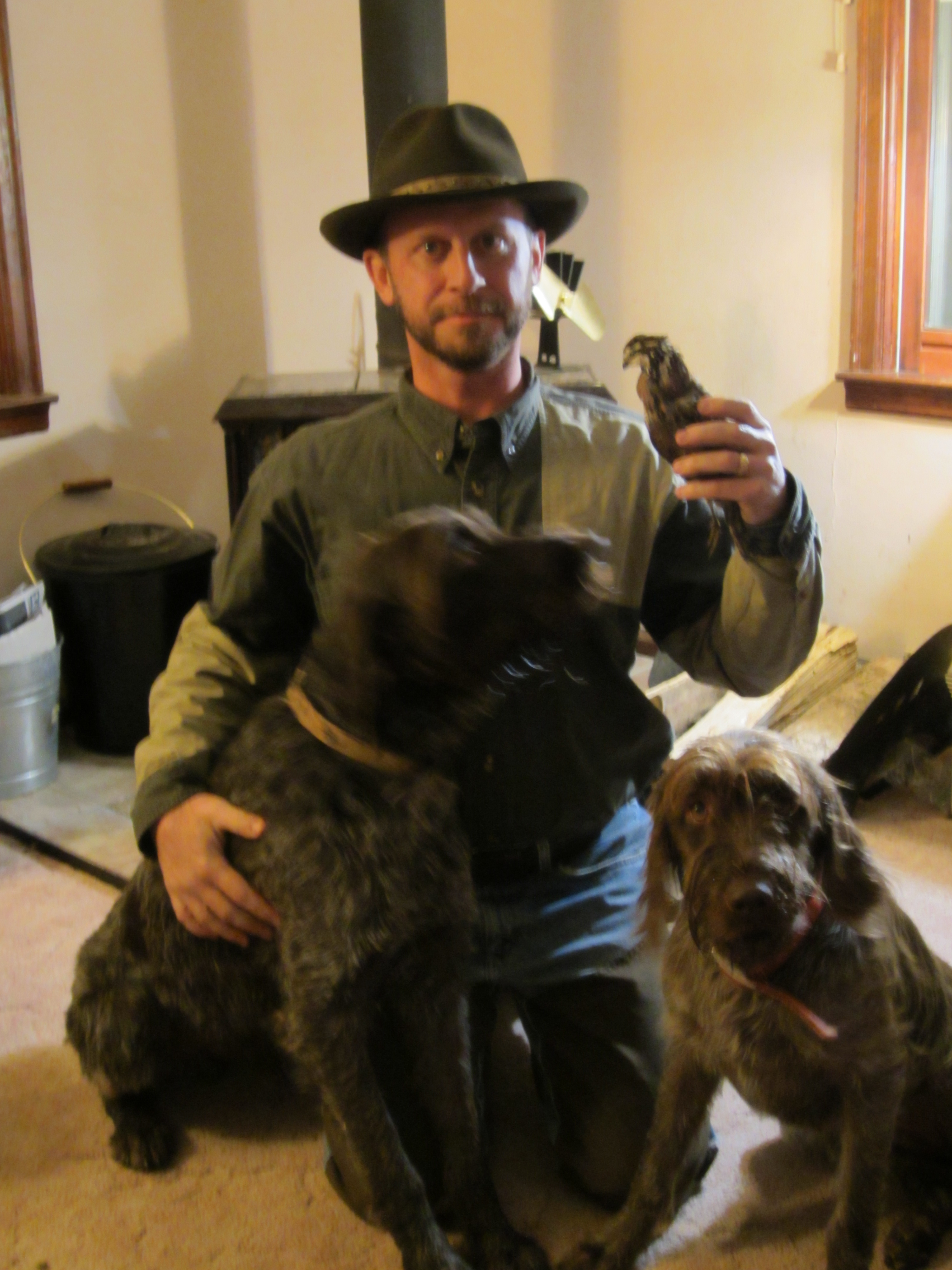
My lone quail, with Sam and BB

The day progressed and after a late lunch, we hit one last field where we had a score to settle with a particularly wily rooster.  This 80 acre piece was all CRP, with brush along the borders.  We worked the entire piece and had some nice dog work on a hen.   As we approached the last clump of plum brush, the dogs put up another hen.   After Matt and I watched her sail away, we took about 4 more steps….now you know what happened next.  Our wily adversary broke cover at 50 yards flying faster than any bird should naturally move.  Undergunned again.  I might have had a chance with a fast moving 1 ¼ ounce load of 4’s out of an improved modified choke, but my fateful decision at the beginning of this trip sealed my fate.

What did I learn from this trip?  Always trust the advice Robert Ruark when it comes to hunting tough game and don’t take a leak in the spot where a lone quail flushes.

Hard Hunting: Sandhills Pheasant

Leave a comment

Late season hunting is always hard, or at least harder than those magic days in October.  The birds are educated and the dogs have to work through thinner, drier cover.  You walk the same coverts, but the results are not the same.

My partner for this hunt was Charity.  She’s my wife and one of the most dedicated “field agents” out there.  One has fewer friends when the days get shorter and the walks get longer.  You need these people if serious bird hunting is your game.

My wife Charity and our dogs Sam and Mae after guiding a hunt on Friday the 22nd

We set out on Christmas Eve with the Yule-tide hope of Sandhills pheasants.  These are a different flock of bird.  They are miles away of any cornfield.  In fact, they have never seen a plowed acre.  Nor have they ever dined on any plot of land disturbed by man.  Food plots are foreign to them.  These birds eke out a living on the edges of wetlands and fill their crops on the particulate matter of swamps, bugs and wild-sunflower seeds.  While these birds are not robust by pheasant standards, they are wild.  Very wild.  They survive in a niche no sharp-tail would tolerate and no prairie chicken would accept.  If one were to transverse the wilds of Eurasia their cousins would be waiting, but only briefly.

Our first push circumnavigated a popular duck hunting marsh in north-central Nebraska.  I’ve sat in a duck blind here, only to have a rooster stalk me and cackle “good-morning”.

Working the frozen marsh

However, today they were sparse to the point of nonexistent.  With Sam and Mae we covered every likely haunt with no results.  Aside from some good dog work and a flush from a hen that was impressive in her strength and speed out of cattails that were thick as any mess you’ve ever seen or waded through, we got nothing but a good workout from this endeavor.

We moved on to another spot after crossing a frozen lake that, while populated by ice fishermen, was eerie.  Moaning, popping ice is not fun to cross.   But after walking 3 miles through semi-marsh, you take the most direct path to the truck if the opportunity presents itself.

Crossing the ice

Our next push was easy at first and very obvious.  A strip of willows through a frozen marsh, with hawks cruising the area, can only mean birds.  We dropped all four dogs.   They pushed to the west and as we approached the edge of the frozen lake this slough fed, birds began to break.   At first it was two hens, but then a rooster broke cover.  He cleared us, but his friend wasn’t so lucky.  Rooster #1 sailed a quarter mile away.   His partner was stopped cold by a load of steel 4’s.  After the retrieve, Charity and I swung the line by 180 degrees and followed the first legal bird of the day.  This time the wind was at our backs, so the dogs had to shift their game.  The ranged out and worked back to us through the thigh high sedges and cattails.  We pushed a half mile, but this bird was not to be shot.  He broke and sailed onto a private piece of ground.

A hard-fought Sandhills pheasant

Christmas afternoon we returned to the same spot, but decided to hit the dunes for grouse.

Searching the dunes for grouse

Over two hours we covered four miles, saw deer and a coyote, but no birds presented themselves.  It was a beautiful afternoon.  Clear skies and 50 degrees days in late December can’t be ignored.

Hard hunting is what it is.

Unexpected Fun

1 Comment

Southeastern Nebraska Pheasants

BB, Sam and I had a great morning!

Sometimes your best times in the field are completely unplanned.  Last Saturday was a striking example of that semi-accurate truism.

The events that led up to one of my most pleasant Nebraska bird hunting surprises were set in motion earlier in the week when a fellow abuser of boot-leather (aka a Southeastern Nebraska pheasant hunter) approached me about joining him on a piece a private ground he had access to.  Never being one to pass up access, but being of a careful nature when it comes to such unexpected good fortune, I asked a few questions.  Specifically, how many other hunters would be joining us and are there any quail in the area?  When he replied “None” and “We always see a covey or two”, I committed.

We met at my place well before sunrise the following Saturday, loaded up the dogs and made our way south into what is considered the worst pheasant country in NE.  While this is considered the worst for large colorful roosters, it is decent quail country, if you can find coveys that have not been over-shot.

As the sun rose and legal shooting time came and went, we came upon a piece of CRP-MAP ground that looked as prime as any Dakota field.  Despite having all the appearances of prime potential, fields such as this have disappointed in the past, but we decided to work this particular one anyway.

We exited the vehicle in a hushed manner.  Any rooster in these parts knows that slamming car doors, big talking and sound of dogs means trouble.  Within 5 minutes I saw Sam get birdy and start working his way to the waterway in-front of us.  Liking the look of things, we picked up the pace and moved towards the dog who was already locking up.  As we approached, a rooster flushed in my direction, crossing my line of fire at less than 30 yards.  What?!  That never happens in these parts.  One expects to walk at least 3 hours and have flushes at a minimum of 60 yards this time of year.  My partner’s discharging gun snapped me back into focus and I quickly ended this bird’s plan of escape with a round of 6’s.

The next bird was rousted in a very similar fashion as we approached the next waterway.   This time Sam worked the bird, which made the mistake of heading my way.  BB was also birdy and ended this bird’s escape plans.  Again I was surprised to see a rooster emerge from the giant ragweed and fly in my direction.  He too was dropped within 30 yards and BB moved in to make the retrieve.  Seeing this made me very happy.  Relative to her size, lugging an adult rooster was an accomplishment.

We moved on and put up a few hens off points, which is fun and good practice for the dogs.  As we made our way along the perimeter of the field, Sam became quite interested in yet another waterway and the rest of us happily followed his lead.  We were all frankly giddy with 2 birds in the bag in 30 minutes.  My partner Matt and I straddled the waterway and followed it downhill.  As we got to a point where it flattened out, both dogs became intense and went to work on a thick clump of sunflower.  Jackpot, another rooster made the mistake flying into my line of fire, albeit behind me.  My partner and I both hesitated a moment as we turned for the shot, as any shot that requires spinning around requires attention paid to one’s companions.  The rooster was now directly in-front of me and the bead of my SKB.  Seconds later he was in Sam’s mouth, making his way over to my game bag.

Matt and I stood there very surprised that we had taken 3 roosters out of a public field, in Southeastern Nebraska after 40 minutes in the field.  The dogs made it happen, but the Hunting Gods obviously smiled on us.

We went on to bust a decent covey of quail, which broke a 2 year dry spell for me.  What a morning!

Nebraska Quail
The lone quail of the day

Later that day we moved on to the private ground and saw precious little.  The long breaking rooster toyed with us, but that was it.  I guess those unexpected successes in the field truly are the best.

Nebraska Pheasant Opening Weekend 2011

Leave a comment

Opening Day, Saturday, October 29th

We were a little surprised to see a fellow pheasant hunter with a truck bed full of dog boxes joining us at the Bellevue Quik Trip to collect the morning coffee, as the forecast was foreboding for opening day.  Hunting tradition in Nebraska doesn’t yield to any man’s dissent and even in the Omaha suburbs folks were up early to head out into the yonder fields.

Prior to our southbound journey, we first had to pick up our old friend, Marvin Brinkman.  The annual opening hunt is always hosted by Marvin and his parents, Wilmer and Maude, on the family farm near Sterling, Nebraska.  Due to the high price of corn and soybeans this year, the Brinkmans hold some of the last CRP in Johnson County.  The Conservation Reserve Program provides the farmers a pittance in exchange for maintaining prairie in comparison to the going rate for corn and soybeans.  Luckily, the elder Brinkmans are past tractor-driving age and are also conservation-minded people.  In years past, large parties of pheasant hunters have traversed their fields with high hopes of bagging limits, and several were successful back in the 1990’s, but this year we simply hold the hope of seeing birds.

On our southbound journey in the dark, we entertained ourselves with tales from Charles and Marvin’s deer harvesting era, when they would obtain every tag they could and bag numerous deer a year.  Our garage was a game cleaning station and the chest freezer frequently overflowed with venison.  Yet I digress and should save the stories of yesteryear for summertime when there is no hunting to report.

Brian Koch of Ultimate Upland http://www.ultimateupland.com/ met us in Syracuse to experience and photograph the hunt.  Brian has been on the road since September, camping and hunting in North Dakota, Montana, South Dakota and now Nebraska.

We arrived to our first field prior to shooting hours, so we visited in the truck for awhile, then geared up with the hopes of pheasant or quail.  The 40 or so acres of native prairie were surrounded by standing corn to the north, east and west, with a small waterway on the south bordered by trees and shrubs.  Our path began on the southwest corner of the property, pushing east.  The guys took to the field, while I weaved in and out of the thicket next to the waterway.  About 15 minutes into our push, I heard slight and distant wingbeats, with the flush of three small bobwhite quail catching my eye from the field.  Marvin and Charles elected not to shoot, hoping to allow the covey to grow in the future.  Our hike continued and my 7-year old female griffon, Sue, joined me in the brush, acting birdy.  Charles was hitting the whistle since he couldn’t see us, but Sue locked on a solid point, nose to the ground, not moving an inch, as if to say, “it’s right there, mom!!”  Sure enough, I kicked my foot right in front of her nose and a single tiny quail alighted and weaved its agile flight back into the branches, evading my shots.

It doesn’t take very long for three primed up hunting dogs and four people to cover the field and cross the road to hit the 15 acres on the other side.  Even though no further bird activity was detected, it was a beautiful morning now that the sun was fully awake and I couldn’t help but singing the state song in my head as I watched the golden leaves drift to the ground in the breeze and the seedheads of the big bluestem sparkle like delicate Swarovski crystal ornaments in the morning light (my favorite version of the Nebraska state song: http://www.youtube.com/watch?v=g6ADhHMLgZk)

Charity, Charles and Marvin strategize the next move. Photo courtesy of Ultimate Upland

Next stop was the “sure thing”, 80-100 acres of prime habitat, dissected by a waterway and surrounded by standing corn.  We pushed the first three quarters of the field, seeing nothing and becoming nervous that even the “sure thing” was going to be a bust.  We ambled back towards the truck, southbound down a mowed swath bordered by trees to the west and some rocky, forb-covered dirt mounds to the east, walking together and chatting excessively as if we had given up.  The dogs never quit hunting and they all locked up on a thick spot, which the hunters ran to surround.  A rooster flushed with both Charles and I taking shots.

BB looks on as Charles and Charity take shots. Photo courtesy of Ultimate Upland

Convinced that I had shot the bird, Sam brought me the retrieve and the debate ensued as to who shot the bird.  Following the official review, I was granted the bird.

Charity and Charles take time for the official review. Photo courtesy of Ultimate Upland

The hunt took a serious tone now that the game was on, especially where Charles felt that his bird was stolen from him.  We followed the curvature of the treeline towards the gravel road, when Sue got birdy in the thick and a rooster spooked by surprised.  Brian had noticed that we might be getting into a shot, so he turned on the BlastCam and captured the moment of Charles taking down our second rooster of the day: https://www.facebook.com/photo.php?v=2458542390300

Sam brings in the retrieve as Marvin looks on. Photo courtesy of Ultimate Upland

After this bird was collected, we swept the corner of the field and decided to post Marvin up on the edge of the road at the end of the waterway, a spot where the guys had always put up birds.  Charles, the dogs and I pushed the waterway into the thick of trees and weeds right by the road, but nothing popped out.  It was getting up on lunch time, so we drove towards Sterling and quickly hit a waterway on some land that the Brinkmans rent out for farming, but nothing was to be found.

Scott’s Place, the watering hole of Sterling, was filled with the town’s usual suspects to view the Husker football game against Michigan State.  Everyone was abuzz with Big Red on the board, greeting Marvin as one of their own and wanting to know how our hunt was going, “We’re on the board, too!” I exclaimed.  We settled in for some iced tea and the special of the day, ending up taking a three hour lunch talking dream bird hunts, pheasant management practices in Nebraska and enjoying the raucousness of the football game.

Our final destination of the day was the “home place”, 120 acres of CRP in the middle of cornfields, with a fish pond in the middle.  We had almost completed an hour long push of the property when the dogs got really birdy on our return trip to the truck.  We had a rooster running, straight towards the corn, where despite our juking and jiving, he got away.  The dogs put up a hen in the corn and we assumed that it was the bird we had been chasing.  No longer than 15 feet from the truck, guns broken open, the dogs bust the rooster out of the standing corn to our chagrin, with nobody prepared to shoot.

It was time to pay our hosts, Wilmer and Maude, a visit and present them with a gift of authentic German ring bologna that we purchased for them in North Dakota.  One must always go bearing gifts when given the special opportunity to hunt private land with permission.

Nobody came into this trip expecting a limit.  The excitement of the hunt was seeing that there are still wild birds in southeastern Nebraska.

Landowner Marvin Brinkman, Charity, Charles and Brian Koch of Ultimate Upland

Sunday, October 30th

We awoke Sunday morning, grabbed the morning Omaha World-Herald from the yard, and drank our coffee with no intention of a hunt entering our minds.  That was until we turned to the Sports section and read David Hendee’s account of opening weekend.  He had traveled out to Broken Bow’s Pressey Wildlife Management Area, which was stocked with pheasants by the Nebraska Game and Parks Commission for the previous weekend’s youth hunt.  The article took the tone that NGPC and Pheasants Forever were disappointed with the hunter turnout at the stocked WMA’s.

Game on.  Charles quickly got his hunting clothes on, while I dressed our 7-year old son to follow Charles on a hunt at Twin Oaks Wildlife Management Area southeast of Tecumsah, which was also stocked for the youth hunt.  My little guy would never have made it through a full day, wild bird pheasant hunt in Nebraska.  The stocking of the wildlife management areas allowed Charles to go out and bag a couple of birds in a couple of hours; he hit the field at noon and was coming home by 2 PM.  “There were more birds to be had,” he said, “and the dogs would have found them, but I wanted to keep it fun for Conrad.  Making it not fun would have defeated the purpose.”

Conrad is fired up about pheasant hunting!

Attention Nebraska pheasant hunters: there are still scratch birds to be had from the stockings for the youth hunt weekend.  Please patronize Twin Oaks WMA southeast of Tecumsah, Branched Oak WMA northwest of Lincoln, Pressey WMA southwest of Broken Bow, Sherman WMA northeast of Loup City and Oak Valley WMA southwest of Norfolk on your hunts this weekend.  Thank the Nebraska Game and Parks Commission and Pheasants Forever upon your success in order to continue this opportunity for hunters in our state!

Nebraska Duck Opener: A Versatile Hunting Weekend

1 Comment

You know that it’s that special time of year when you’re driving through the dark at 8:30 PM and the farmers are still in the field harvesting grain.  Another late night run from the Eastern Nebraska metro to the Sandhills for three die-hard duck jumpers.  Charles and I were joined by one of our usual hunting buddies, SSGT Ryan Tompkins, who returned from Army deployment in Afghanistan earlier this year and is also an Iraqi Freedom veteran.  Since duck didn’t open until Saturday, we enjoyed sleeping in on Friday and getting out into the dunes close to midday.  The grouse don’t care what time we show up.

Almost as soon as we started hiking, we bumped a pair of sharpies at about 200 yards.  We figured that if we chased them long enough, we would wear them down and get close, but this pair really led us on.  One and half hours and three flushes later, they totally gave us the slip.  “I am not spending my whole day chasing two grouse,” I told the guys.

They agreed.  What we originally set out in front of us as a nice, easy day took a tone of seriousness as we marched deep.  The wind out of the south was fierce, so we set our faces towards it and placed our bets on them sitting either on the north side of the dunes or down in little bowls.  As we climbed higher, a pair jumped up in front of Ryan and he brought one down.  Typical to the long process of grouse hunting, our first bird of the day was two hours into the trip.  We continued southeast into some high chop, expecting to see something but didn’t.  As we came to the eastern end of the dunefield, Charles suggested that we come down from the heights and swing back west low on the flat to the north of the dunes, as this was prairie chicken country too.

As we strolled back westward on the flat my mind was not on birds.  It was hot, windy and at this point we’d been on the march for three hours.  Two chickens jumped in front of me and I was admiring them drift over the little hill, as the guys are yelling, “Shoot!!!  Shoot!!!”  I took Hail Mary shot just as the bird was cresting the hill and it went down hard in a poof of feathers.  I called my six-month old griffon puppy over to me for a retrieve attempt and she gave the downed bird a solid point.  I gave her the fetch command and she started to scoop the bird into her mouth, but in her hestitation, three year old Sam came in and snagged the retrieve.

I was very satisfied with my big male prairie chicken and knew that if I decided to stay with the guys that it would be anything but an easy day, as Ryan and I each had a bird in the bag and Charles had nothing.  My slow walk back to the truck was marked by the sound of the guys’ gunfire.  The easy route was through a valley filled with ponds, so as I was dodging some wet spots on the side of a dune, I pushed up a group of about 20 sharpies.  I cracked off a couple lackadasical shots, but didn’t connect and didn’t care that I hadn’t.  Wanting to be sure that the guys had more birds, I went back in their direction to give a report of this new flock.

When I met up with them, probably an hour after I broke away and headed towards the truck, Charles had his limit of three and Ryan had gotten one more.  Charles got to see one of his favorite sights, which is when both of our two adult dogs have birds in their mouths.  They were all satisfied and ready to call it a day.  We figured that between all of our flushes, we had seen 40-50 birds that day, which is more than we had seen any day all grouse season.

Charity with her prairie chicken, Charles with a limit of three sharptails and Ryan with two

The opening day of duck season came early, as it should.  We chowed on a large McDonald’s breakfast and hit the road.  Our first jump came on a set of potholes, chock full of snipe.  Charles called us off of the snipe, for fear of scaring any ducks that may be resting in the puddles.  Only fifteen minutes out of the truck, we spotted a duck-like flutter in the water.  In a flush of little ducks, all three of us each got a blue-winged teal.  Such pretty little ducks, teal are definitely one of my most targeted.  Unfortunately, the snipe had scattered as we made our way back to the truck, but a random dove found its way into my sights and I decided to take it.

The second pond we jumped has been a “problem pond” for several years.  Either we jump it with nothing sitting in it, or we roll up on it in the truck only to have ducks everywhere.  As it is a pond that we know well, we went tactical on it, with BB and I sneaking up on the west side and the guys with Sam on the east.  Crouched on the banks in the grass, we signaled to one another that we were ready to jump.  So in we went.  The first flush was a big group of teal.  Ryan and Charles each took one of those.  As they searched for their downed ducks I made my way down the bank, missing an easy shot at a beautiful drake woodduck, which made me mad for the rest of the day.  Took down two coot, then headed back to the other end of the pond to see how the retrieves were going.  They were still short a duck, so they asked that I head back to the truck for the more methodical dog, Sue.  Slow working Sue took no time at all to find the missing duck while Sam tracked down my two coot in the water.

On we went to the creek that we were going to walk.  The entry point is a large pond, so we snuck into that.  Ducks everywhere!  I took two, Charles took two and Ryan took one.  We had to stop, collect Sam and Sue’s hard fought retrieves and identify what we had in order to be sure that we weren’t violating any waterfowl regulations.  All five were ringnecked ducks, the first that we had ever taken.

We worked our way down the creek and I busted another flock of teal.  I was sure that I had wounded one, but it wasn’t retrieved until a couple of more flushes of it, an hour or so later on our way back down the creek.  It’s amazing to watch a dog aggressively seek out a bird that was downed so long ago, without dogs we never would find a bird like that.

Ryan took a couple of more cracks at coot, but a herd of cattle had worked their way down the creek in advance of us, so where we thought there would be dozens of ducks there was nothing.  We worked the area for another hour or two with no results.  It was our usual Saturday steakhouse night, so we were ready to head back to town, clean up and go out for some beef.

Ryan's 2 blue-winged teal, 1 ringnecked duck and a coot, Charles took 2 blue-winged teal, 2 ringnecked ducks and a coot, Charity's 2 blue-winged teal, 2 ringnecked ducks, 2 coot and a dove

We headed out early again Sunday morning for some new territory.  The ducks had obviously been shot at previously, because in addition to terrain challenges (lack of cover) we had no chance at ducks for four or five ponds.  There were five coot taken that day, which Sam worked very hard to retrieve.  We even went so far as to try to belly crawl for 30 yards through cow pies and cacti, but still busted a flock of mallards way out of range.  It was a full day and a full weekend, so we were ready to head back to camp for some grouse fajitas.

Although our last day felt like a bust, looking at the weekend as a whole there was no reason to complain, as a successful versatile hunting trip had been achieved.

On our last day, each of the guys took 2 coot with 1 for the gal

Easy Grouse Fajitas:

6 grouse breasts, sliced thinly against the grain of the meat

4 packets of fajita spice mix

1 can of beer

A sliced red bell pepper and a sliced green bell pepper

Tortillas

In a bowl, mix sliced grouse breast strips, 1 can of beer and the 4 fajita spice packets.  Marinate for two hours.  Place a small amount of oil in the skillet, evenly spread a handful of the grouse breast strips and cook to medium rare.  Do not overload skillet, cook strips in 3-4 batches.  Set meat aside to cool while you sautee the peppers and warm tortillas.  Serves 6-8

Coot Vindaloo:

The cleaning of the meat is the most important part of this recipe.  The skinned and de-boned coot breasts should be free from visible fat and “silver skin” (transluscent whitish thin layer of fat that covers many game meats, such as venison) and should also be washed in cold water to get rid of excess blood.

Vindaloo is a very spicy Indian dish and should not be attempted by those with weak palettes.  Also keep in mind that it is a two day process, so start a day before you want to eat it.

Day One:

Breasts of 4-6 coot

1 pod of garlic

3 inch piece of ginger root

3 teaspoons prepared mustard

2 tablespoons cumin

2 teaspoons coriander

De-bone, de-fat and wash the breasts of 4-6 coot, cube into 1/4 inch pieces, set aside to bleed out a bit while you prepare the spices

Shred ginger root with a fine grater.  Crush and finely chop garlic pod.  Mix in a small bowl with the rest of the spices, adding vinegar to create a fine paste.  Drain the excess blood off of the coot cubes and rinse one final time.  Mix coot in the spice paste, then place in a glass jar and refrigerate for 24 hours.

Day Two:

10 dry red chilis

1 medium white or yellow onion

1 tablespoon of butter

1/2 teaspoon of tumeric

Jasmine or Basmati rice

Naan bread (optional)

Roast the chilis in a skillet.  Once roasted, place chilis in a mortar with a small amount of vinegar and grind to a fine paste with the pestle; set aside.  Start the jasmine or basmati rice per the directions on the bag.  Finely chop onion.  Place butter in a skillet over medium heat and brown the onion until transluscent.  Add tumeric to the onions and cook briefly.  Add your jarred coot meat and the chili paste.  Cook covered on very low heat until the meat is done, typically 5-10 minutes.  Once the rice is cooked, plate a serving of rice with a serving of the meat mixture on top.  Eat with a side of Indian Naan bread if you choose.  Serves 4

A Day for BB

Leave a comment

Saturday brought us BB’s first solo wild bird adventure in the field, on a snipe hunt with Charles.  It is good for the six month old pup to run with the older dogs to learn the ways of the game, but it is essential that she also be allowed to hunt independently.

As there has been a warm spell up in the northern area of the flyway, the migrating snipe were not yet noticed, just the resident population that we last hunted at our snipe swamp in Southeastern Nebraska.  Charles and BB put up several snipe, but he passed on many shots since the birds start out flying so low to the ground, it is often a risk to the dog.  He also didn’t want to shoot birds on the edge of range, as he wanted an easy “hunt dead” for BB, so that she would not get discouraged.

BB has mastered the art of the search, knows bird scent, gets birdy and points.  Right now we are still working on the retrieve with real birds, as she will mark the bird and pick it up, but not yet bring to hand reliably.  She will retrieve a dummy or dokken to hand without fail in the yard, heck, she’ll even retrieve our 2 1/2 year old’s stuffed animals when he throws them with the fetch command.  It is all just part of the process that we’d like for her to work through naturally within the next few months of hunting, knowing that with her griffon instincts she will put the pieces of the yard training and the field work together in due time.

BB's first wild bird after a long day in the snipe swamp

Newer Entries