
The Nebraska Sandhills
Saturday, September 1, 2012
Charles, Charity and the dogs started opening day at the usual opening day spot, which is a half-mile wide, flat valley with a set of high dunes to the north, running east to west, and a set of shorter dunes to the south, also running east to west. Charles was assigned the higher northern dune set and Charity the southern set. This is the first year that they split up in 13 years of hunting together and will probably continue to hunt this way. Charity’s pace is about half that of Charles’s, so the ability to determine their own speeds was the first reason. The second reason is that running four dogs puts too much pressure on these skittish birds at once. So, Charity took the older females, Mae and Sue, and Charles worked four year old male, Sam, and eighteen month old female, BB.
There are various ways to pattern a dunefield when hunting grouse, but Charity selected a straight up an ambling criss-cross pattern for opening day, starting on the southern, low dunes walking west to east, then turning back, walking a bit higher going east to west, then back again in the high chop going west to east. It was in the high chop an hour after starting out that she flushed her first single sharptail just barely out of range, firing shots that didn’t connect. A few steps later, a group of four got up at seventy five yards, flying off of the highest dune in the southern set, disappearing out of view to who knows where. Despite being a bit ragged from each having a litter of pups this summer, Sue and Mae sprang into action once bird activity began. They covered the highest dune to check for stragglers with no success and the descent down the eastern slope began at a frantic pace. So frantic that both dogs and hunter marched right past the sharptail that cackled up behind Charity, so that she had to take the 200 degree shotgun swing for the double-barrel attempt. She saw it wobble and descend, sending the dogs after a retrieve. Sue happily retrieved the first grouse of the season for team Versatile Hunter and it was captured on her new head-mounted video camera. http://www.youtube.com/watch?v=KBoTg3pINGk
Meanwhile, Charles was working the taller northern dunefield, also starting from the west and working his way east in a meandering zig-zag pattern, making sure that either he or the dogs were covering any possible grouse territory in the complex. As he ascended into the target area, a random group of doves flushed off of a high dune and he couldn’t help himself but to harvest one. Not long after he heard the reports of Charity’s missed shot and her success following shortly thereafter, he descended from a dune peak and looked down onto a small flat amongst the choppy hills. Three grouse busted at seventy-five yards, as if they sensed something, but not necessarily imminent danger as they merely popped up and over the next slope. As soon as he entered the marked zone of potential landing, one got up and he shot it at close range straight on, with BB nearby for a quick retrieve.
After Charity and the older females watched the cattle hustle off of the pond on the eastern end of the dunefield and head for the windmill a couple of miles to the northwest, they stopped for a water break before continuing their criss-cross pattern, back to the west on some of the lower dunes, then finally crossing back eastward on the flat right next to the dunes. Charity has taken prairie chickens out of there in years past, but there was nothing to be seen this year. Once she finishing fully covering her assigned area, she and the dogs crossed the valley to meet up with Charles to get the update of his one grouse and one dove in the bag, but he had more ground to cover and an idea where birds were in the high chop. Charity followed the low dunes towards the west and stopped again at a windmill for a break, noting the lack of doves at the spot.
Charles headed northwest from the windmill into an extension of the same northern dunefield that he had been working all morning. He marched his way to the extreme northwest corner and worked his way back and not soon after he reached the endpoint and began hiking back, the dogs got birdy and three grouse flushed within fifty yards, which is in range for Charles even with a twenty gauge. He took one out of that group and while BB was on retrieve, another flushed even closer. His shot merely clipped the wing and the bird began to run. Luckily, catching running wounded birds is one of Sam’s specialties, so while BB was delivering the first bird, Sam put the lockdown on the attempted escapee to round out Charles’s limit for the day.
The sun was arcing higher into the azure sky and getting uncomfortably warm to continue trekking. It was time to return to the truck, which Charity couldn’t see from the windmill but knew it was to the south. She wandered a bit off track, farther east into the valley than she needed to go, but eventually caught sight of the vehicle and made it back just in time to meet up there with Charles.
At first they had it in their mind to sit for doves, but after scoping their two best spots and seeing nothing, they opted to sit out doves this trip and wait until their return to the Missouri River Valley, where they are plentiful this year.
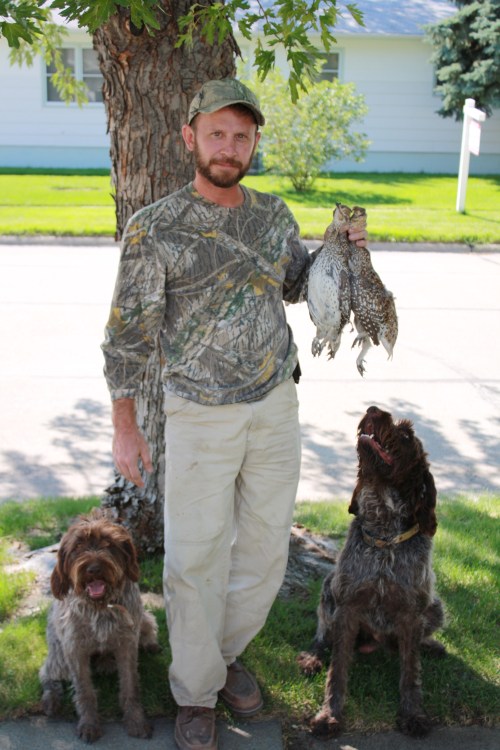
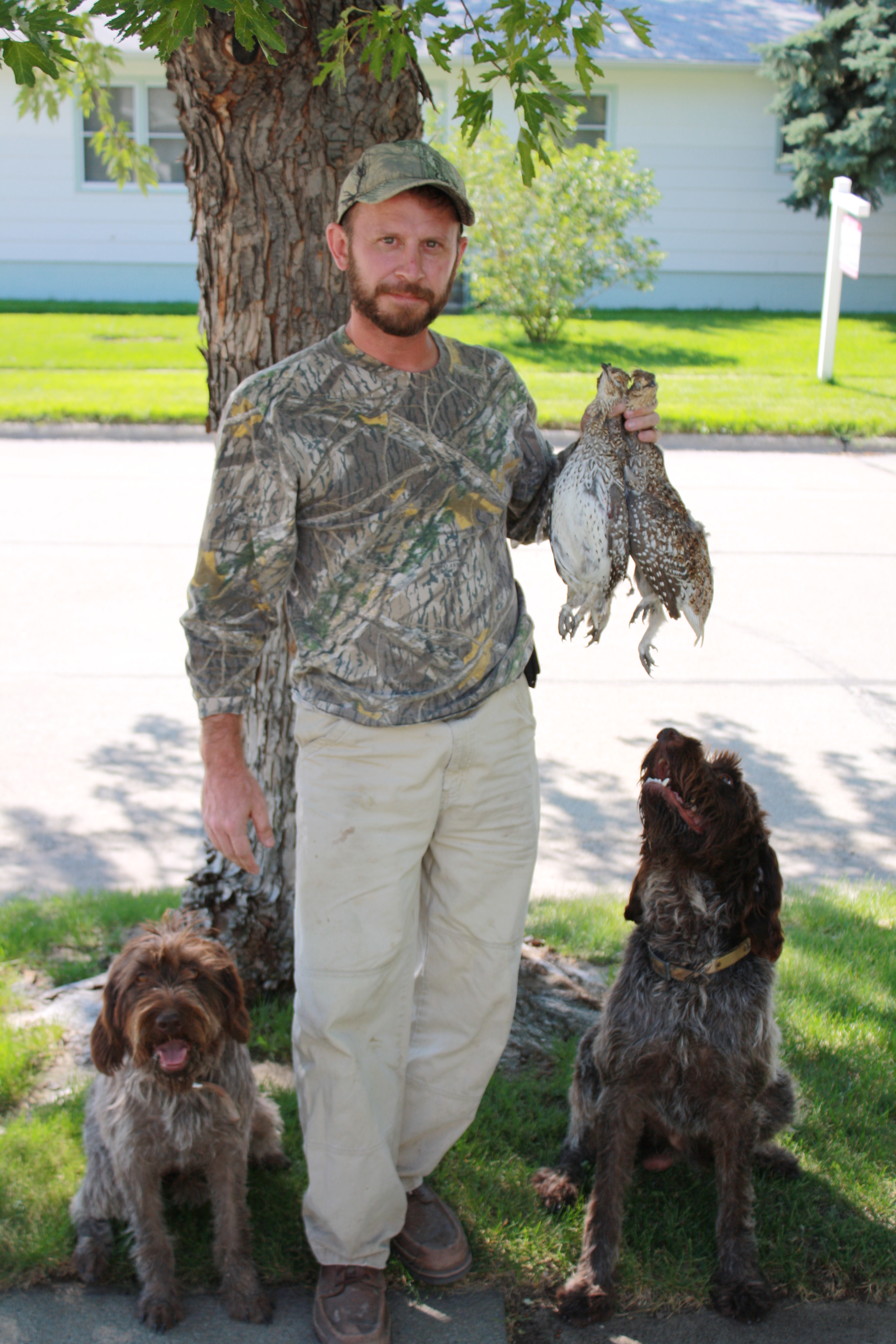
Charles shows off his opening day limit back in town, with BB and Sam, Wirehaired Pointing Griffons

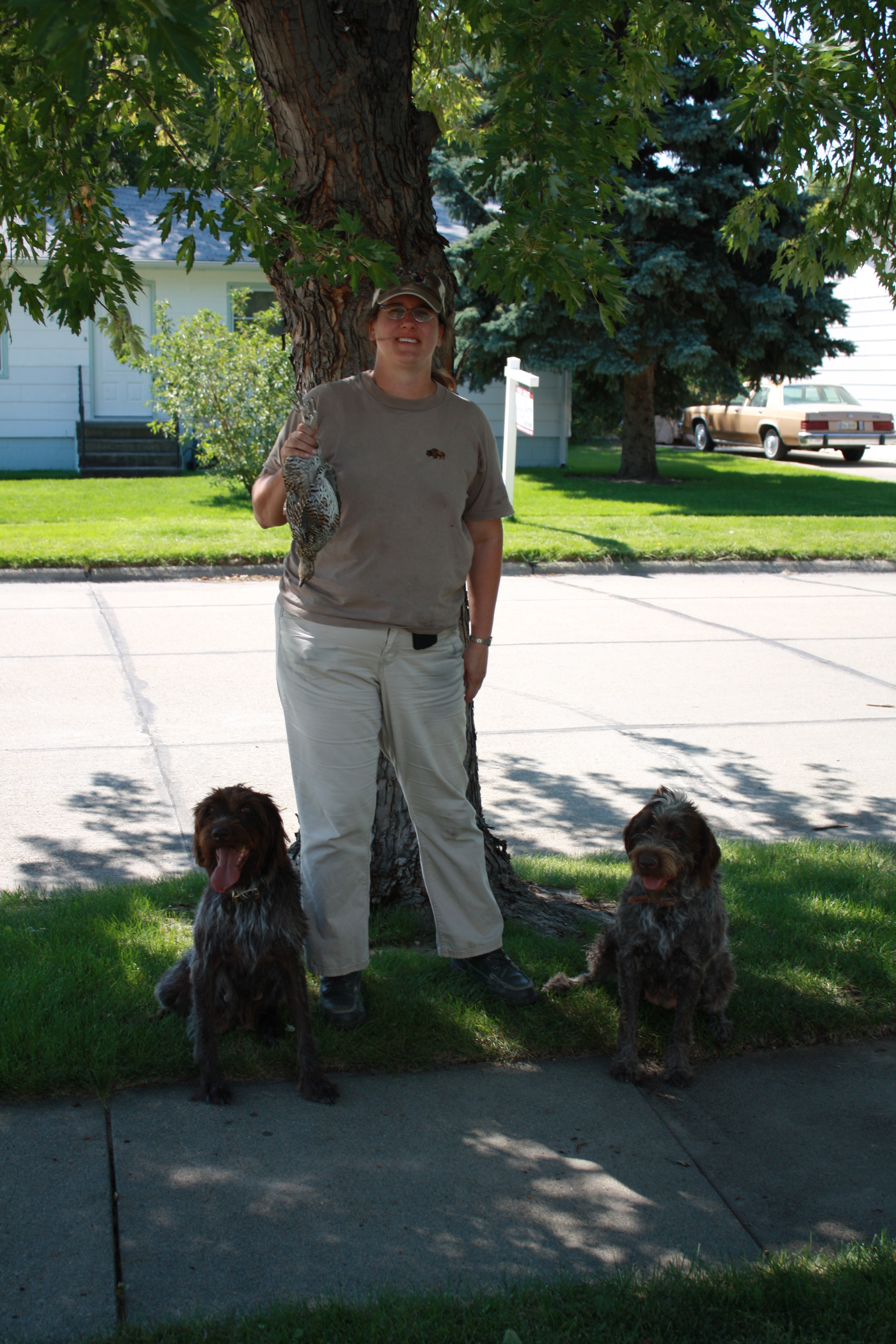
Charity is back in town with her first sharptail grouse of the year, assisted by Sue and Mae, Wirehaired Pointing Griffons
Sunday, September 2, 2012
Day two started early again this year, at the “big hill”, the one over by the “hard road”. As there aren’t many landmarks to speak of in the sea of grass, they are forced to come up with their own for navigational purposes. The valley between the two dunefields was much narrower than the previous day’s, only a few hundred yards, but it was a similar approach with Charles covering the northern side of the valley and Charity the southern. Charity decided to use a figure eight pattern on this area, starting at the south and working eastward towards the middle of the dunes, using the highest peak as the centerpoint of the figure eight, then covering the north side of the dunes. It took her an hour to cover the first curve of the figure eight, stopping at a windmill for a brief break, taking a couple of sips of water. She then continued south, then turning westward to continue her figure eight pattern, back to the high dune as the centerpoint, then covering the north side, completing her figure eight. In two hours of hiking, she didn’t even see a flush in the distance.
Charles took his normal approach into his assigned area and not long after starting to work it, he watched BB run over a dune out of sight and she didn’t check back in quickly like she normally would, so he headed in that direction. Three or four grouse came sky charging away from where BB was last seen, straight towards Charles, with BB in hot pursuit. In order to work on steadiness, Charles elected not to reward bad behavior and chose not to shoot. He marked their likely landing zone back to the west and pursued. Not five minutes later, the dogs started acting birdy and were tracking hard, but once again charged the flushing birds, so he opted out of shooting once again. He did finally get a point out of BB, which is an anomaly in the dry Sandhills, as scenting conditions are basically nonexistent. Charles “whoaed” Sam into honoring BB’s point, then began to kick around the hill trying to flush the birds. But the wind was playing tricks and blowing the scent of a flock from the top of one dune a hundred yards away over to the top of the dune where the dogs were pointing, so the birds saw the motion and activity of Charles trying to find them and flushed way out of range. As he stood at the top of the ridge, he heard the chortling of a large group of grouse over in a dune range that they had never hunted before.
Charity and Charles met up and headed back to the truck for a bit of a break. Charles reported that he heard distant cackling coming from a north/south running set of dunes that they had never worked before, a half-mile across the valley, off to the west. They decided to each take one end of the field, Charity to the south and Charles to the north, zig-zagging to meet in the middle. Charity made it up and into the dunefield and her dogs found a group of three in a pocket of knee-high sumac. She fired off a downhill shot, but the birds were just out of range. As she headed off to take chase, she all of a sudden lost all energy, felt dizzy and her heart was racing. All she could think was, “There is no way that Charles could find me, let alone drag me out of here and I’m not sure the truck could get up here. I’ve got to get back down to the valley so that at least if I passed out he would be able to see me”.
Charles ascended the northern end of the new hunting grounds, just making the climb when seven or eight birds broke unexpectedly soon. Most of them headed deep into the high chop, but others oddly enough headed for some trees on the edge of the dunes. He made his way toward the trees, not usual sharptail grouse habitat, and sent the dogs in to run them out. Sure enough the grouse came running scared out from the trees, then flushed as they came to the prairie edge at about fifty yards out. A pellet found its way to a bird on the shot, but it wasn’t down for the count and sailed into the distance. The bird knew it was in trouble and flushed again at fifty yards, but was hit hard this time and Sam had no problem bringing it in.
They marched higher into the chop, bumping a mule deer buck and a jackrabbit, but BB and Sam knew better than to chase those. Not long after, three grouse got up, then a fourth was a bit slower on the jump that Charles put his bead on and harvested, with Sam once again delivered to hand.
Charity stumbled a few steps at a time back towards the east, sitting down frequently and feeling lucky when she heard Charles shooting just to the west of her, then him finally seeing her stumbling away from the hunt. Her pride wouldn’t allow her to tell him that she was having trouble and was hoping that she would be able to shake off the spell and resume hunting. But after a good 20 minutes of cramping and stumbling and feeling like Gumby, she accepted defeat and just wanted to get back to the truck. Of course, that was when birds got up within her range, but even though she took shots, there was no way that she was focused enough to hit anything.
The birds that she missed raced right past Charles, well within range, but he too was feeling the effects of dehydration and was unable to focus on the task at hand. With two in the bag and the day getting warmer, it was time to go.
They were both coming out of the dunefield at the same time, he with two in the bag and she just happy to have made it out without a medical incident.
Monday, September 3, 2012
As normal for day three, the alarm rang forty-five minutes later than the first two days. Everyone dragged to the truck, sore and tired. But luckily the fresh spot is full of birds and everyone loosened up with the excitement of immediate action. This is a very wide dunefield and they elect to both travel east to west, with Charles to the south and Charity to the north. Charity takes her first and only bird of the day within 10 minutes of leaving the truck. The bird got up front and center, but she failed to disengage the safety at the first shot attempt, but then recovered in time to get a shot off as it veered over to her left. She wasn’t sure if it connected, but swore she saw the bird waver as it topped the dune, so they headed back in the direction of the truck. Mae found the bird and licked the blood and feathers, hesitating a bit on the retrieve. She was called off of the bird and Sue was sent in. The strong natural retrieve is Sue’s greatest gift.
Simultaneously, Charles enters his area, pushing another nice mule deer buck out of his resting place and hits the jackpot not long after, putting up a flock of 12 grouse, which was the only large group of the whole trip. The birds head east, the opposite direction of our intended march, but birds don’t follow our puny human plans, now do they? As he comes into the marked area where he thought they landed, the dogs loop to the west of the dune and he elects to go east, hoping to pin the wily critters down. Out of nowhere, Sam starts barking, which is never a response to birds. While Sam is barking his head off (which Charity could hear in the distance and was hoping everything was okay), a lone grouse flushes behind Charles that he quickly swings behind and kills, marking the bird down and leaving it lay to figure out the source of Sam’s anxiety. Just as he turns back from the bird to look at Sam and his yucca problem, BB emerges from behind the plant with a face full of porcupine quills. Charles pinned BB down and pulled out quills from her face and paw, while Sam continued his barking but learning the porky lesson long ago, Charles was confident Sam wouldn’t tangle with it. Once he released BB from her operation, she immediately went and found the bird for the retrieve while Charles called Sam off of the barking spasm.
Charity continued west through the dunes, having a few groups of 3-4 get up both in and out of range within a span of a half hour, but the shots didn’t come together. She spent another hour heading west towards a couple of windmills and a lone tree, but saw nothing.
The team of Charles, Sam and BB eased along the southern ridgeline that Charity had covered to the north and pushed birds into. One got up that he missed, but a second bird jumped that he put a pellet into. It soared a hundred yards away, but it was obviously hit because one leg was hanging limp despite its efforts to escape. They worked over to where it was down and BB found and pointed it, but the bird hadn’t given up the fight. It flushed again and with a close range going away shot, Charles had no problem bagging it. They worked their way further into the area that Charity had busted up and a grouse charged them out of nowhere, flying up over a dune straight at them. Needless to say, Charles’s limit was taken care of in that salvo.
Despite the remote location, they were within cell phone range and Charles texted that he had his limit and was coming to get her. She made her way to the windmill by the lone tree and he drove the truck to pick her up, just in time to head back to town to fix the kids some lunch.
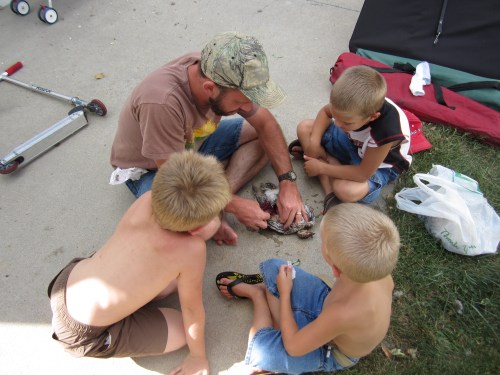
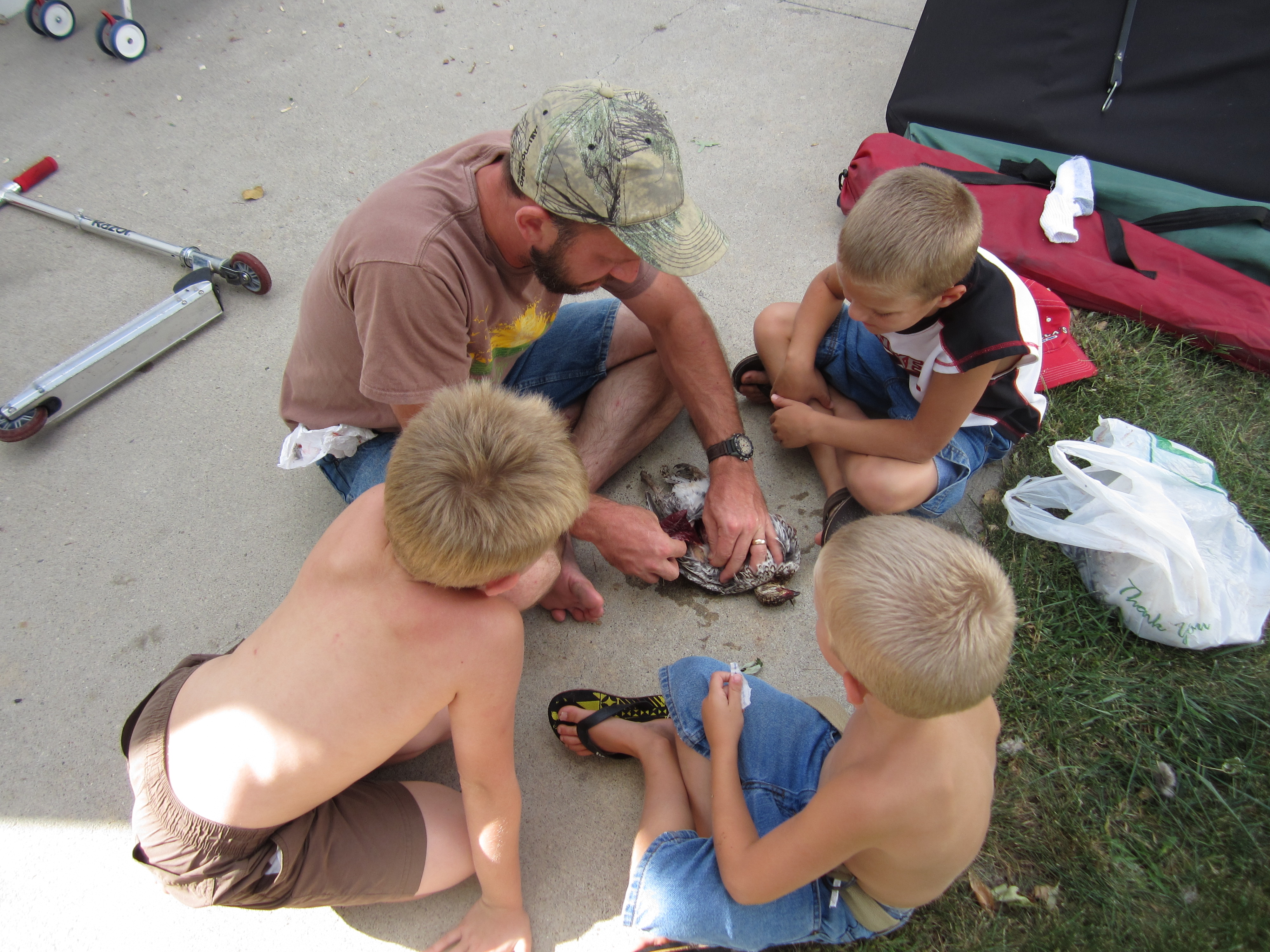
Charles shows the neighborhood boys, along with son, Conrad, on left, how to breast out a sharptail grouse
Tuesday, September 4, 2012
As Charity’s family babysitting time had expired, plus there was make-up homework to help the kids with and laundry to do, Charles headed out to “Prairie Chicken Paradise” on his own. He was making his way out to the paradise, in an area that used to surprise us when birds got up, but we’ve been surprised enough years to now know that a flock resides in these very low, almost nonexistent dunes on the way to our usual hunting grounds a mile and a half away from the road. It was there that he took his only bird of the day, with unknown numbers jumping right into the sun, he instinctively fired at the sound of the wingbeats since he couldn’t see and was able to put one on the ground between him and Sam.
They made their way back to the deep dunefield that has consistently produced for us throughout the years, but not a flush was to be had. BB began tracking hard, so since there seemed to be nothing else going on, Charles and Sam followed along. BB was tracking a coyote, who jumped up and ran, but Charles was in no mood for fur and called the dogs off to head for home. It was time to enjoy the company of our family and good friends in the Nebraska Sandhills.
Despite the long summer drought and unseasonably hot conditions, Charles, Charity and the dogs were able to have success on their traditional sharptail grouse and prairie chicken opener by relying on proven approaches to covering ground and relocating known coveys that they’ve hunted for over a decade.

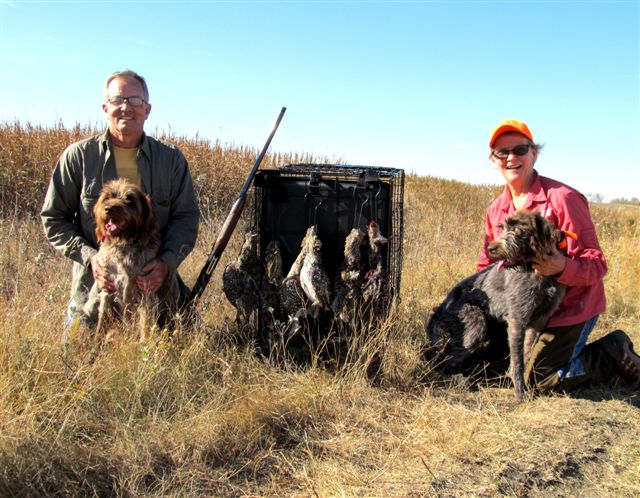
Preparing the trip’s harvest for the freezer, minus 2 grouse that were already consumed.
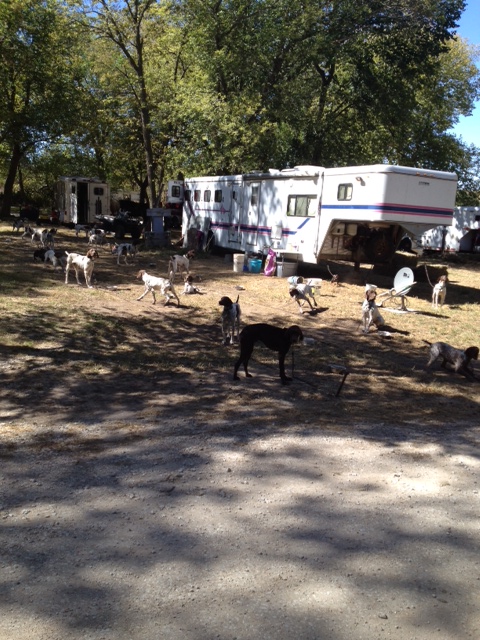




 Bluestem Kennels